Key Climate Indicators
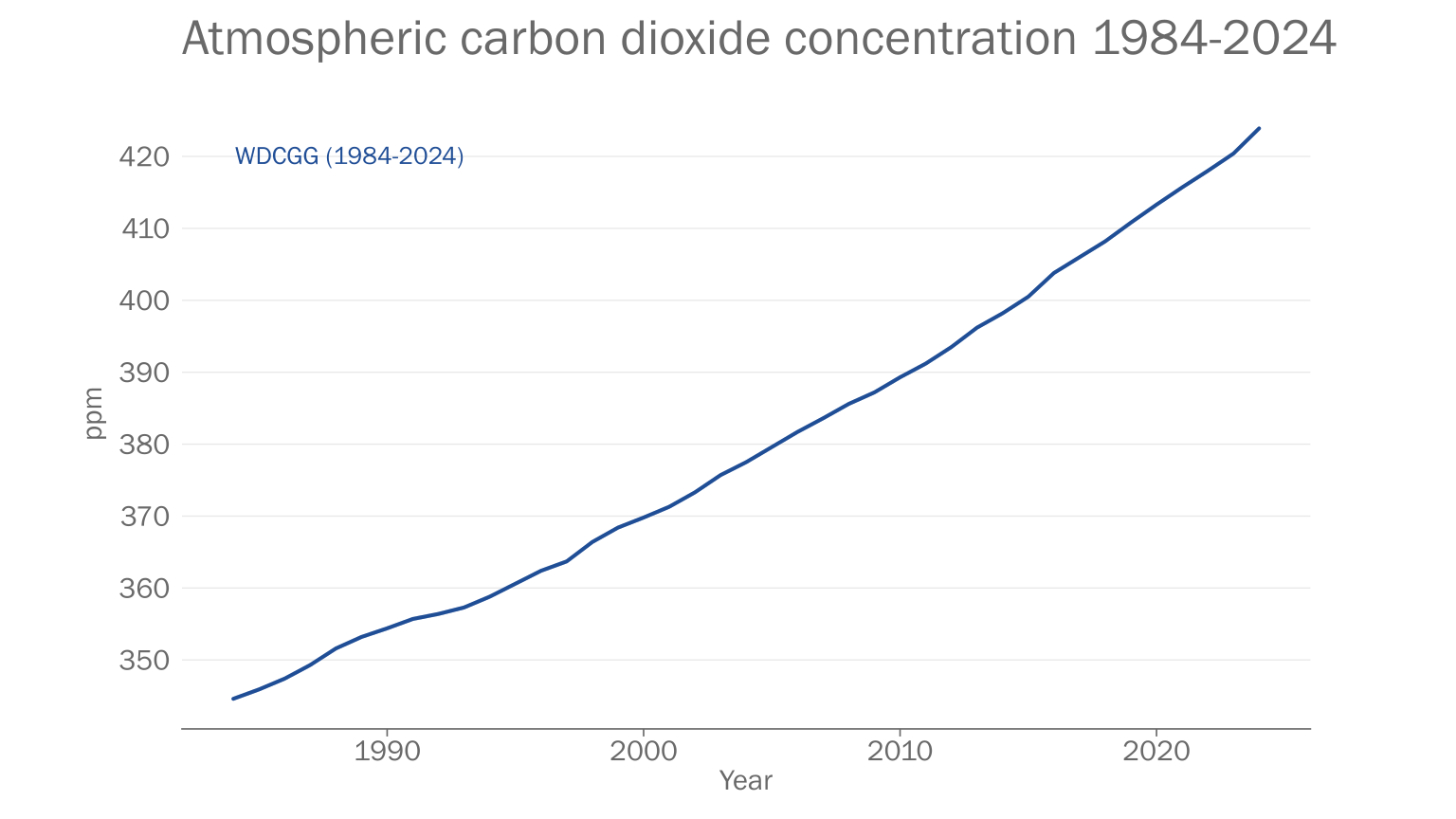
Greenhouse gases
Global temperature
Ocean Indicators
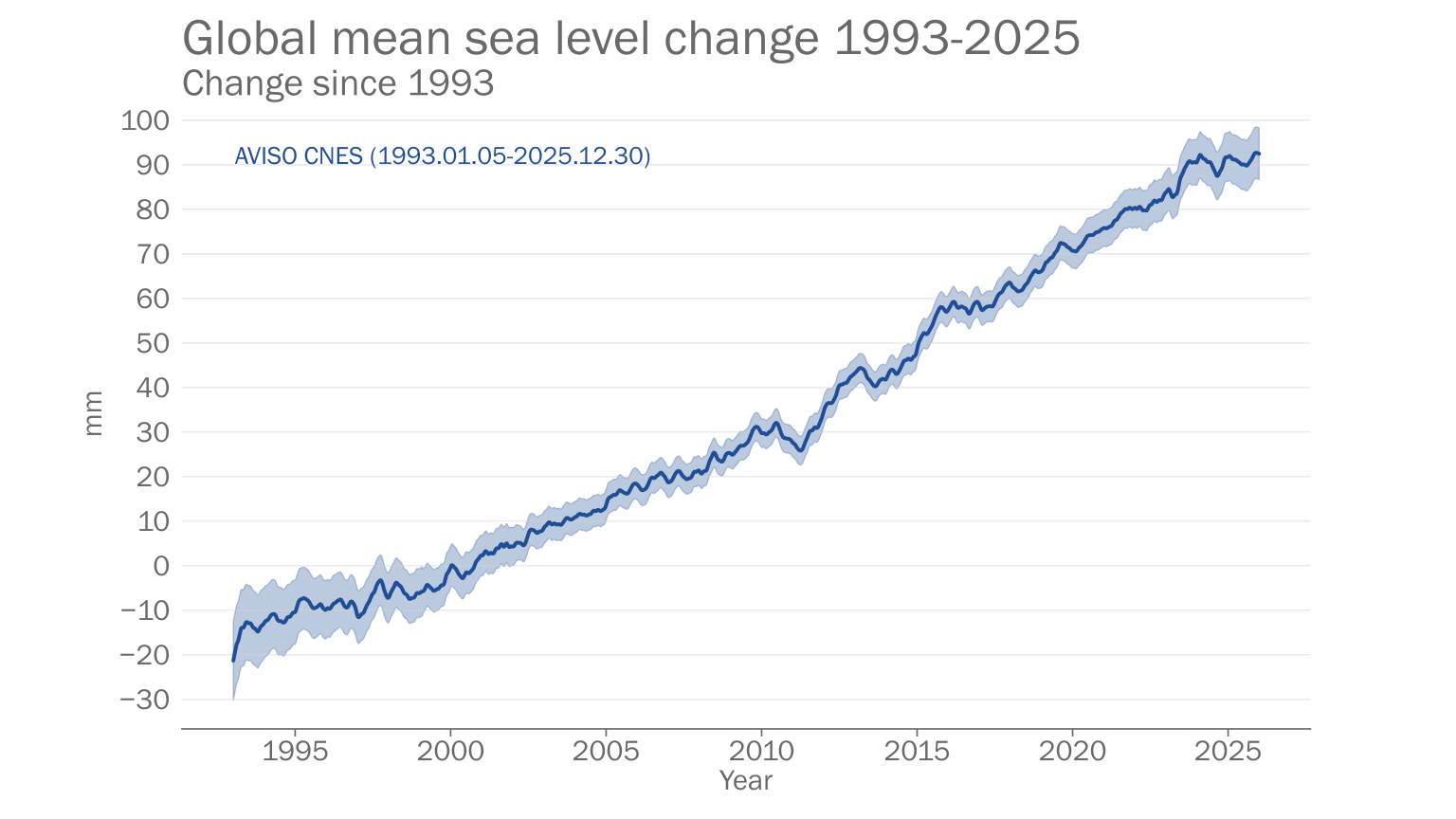
Global mean sea level
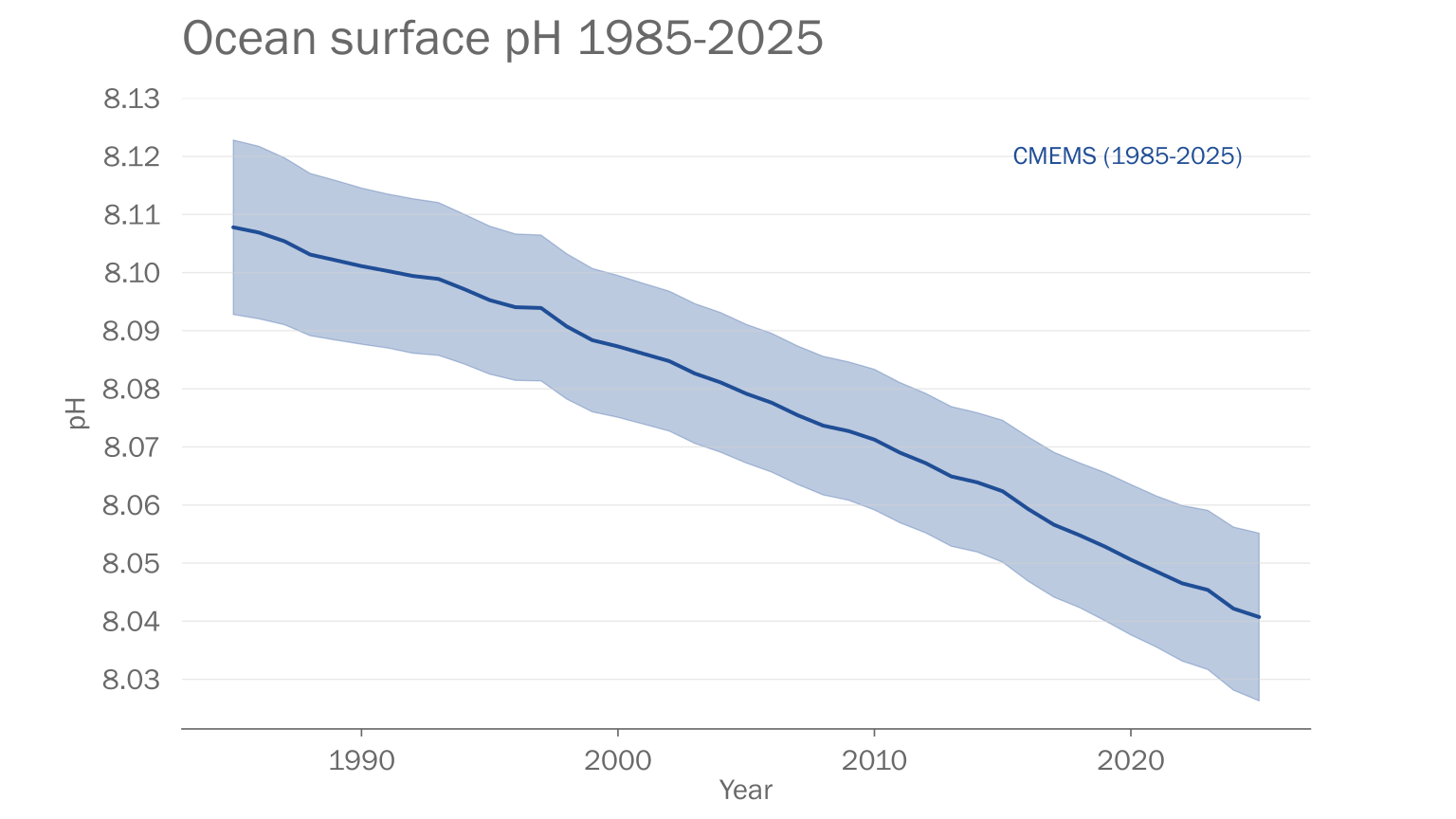
Ocean surface pH
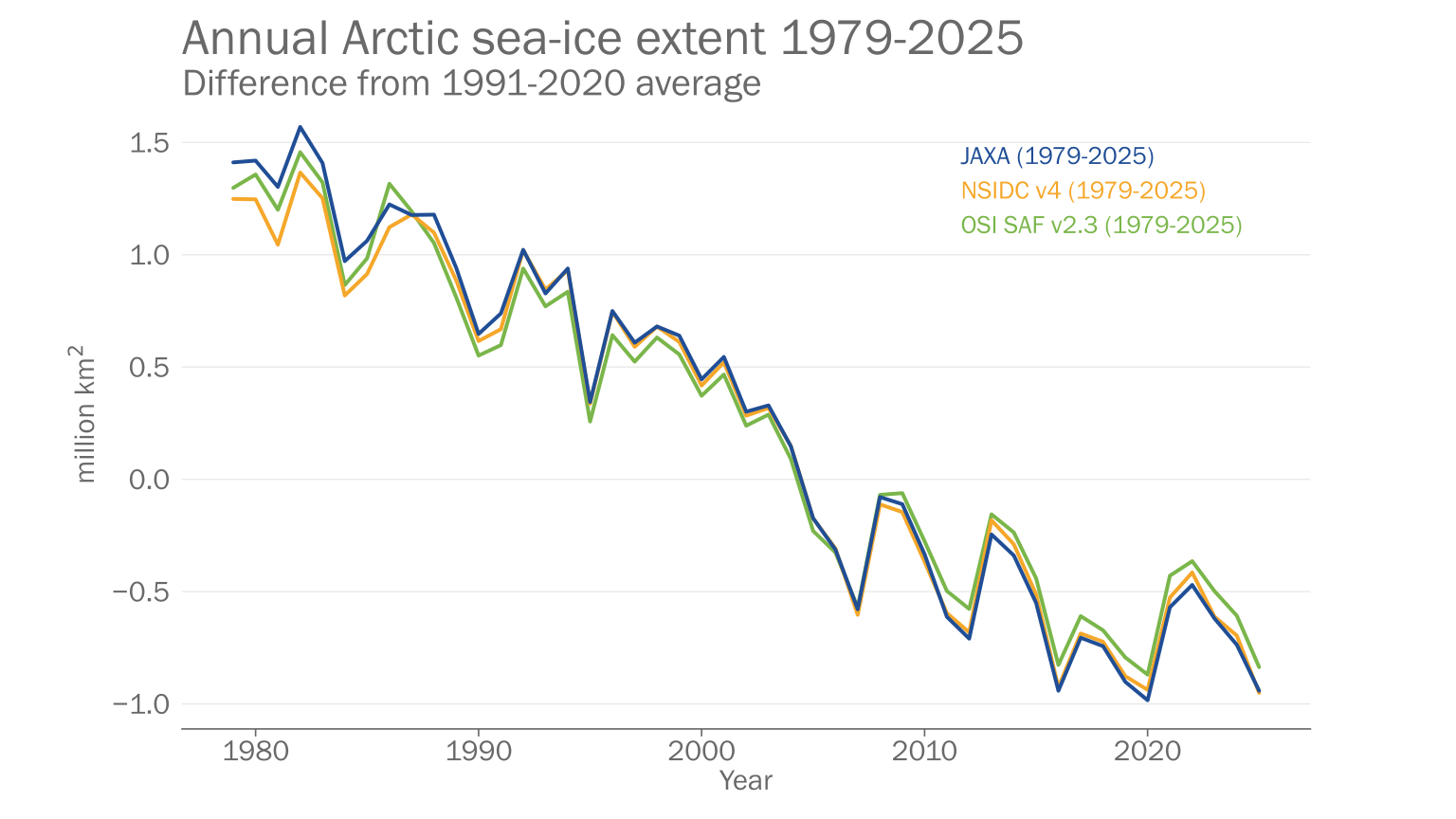
Annual Arctic sea ice extent
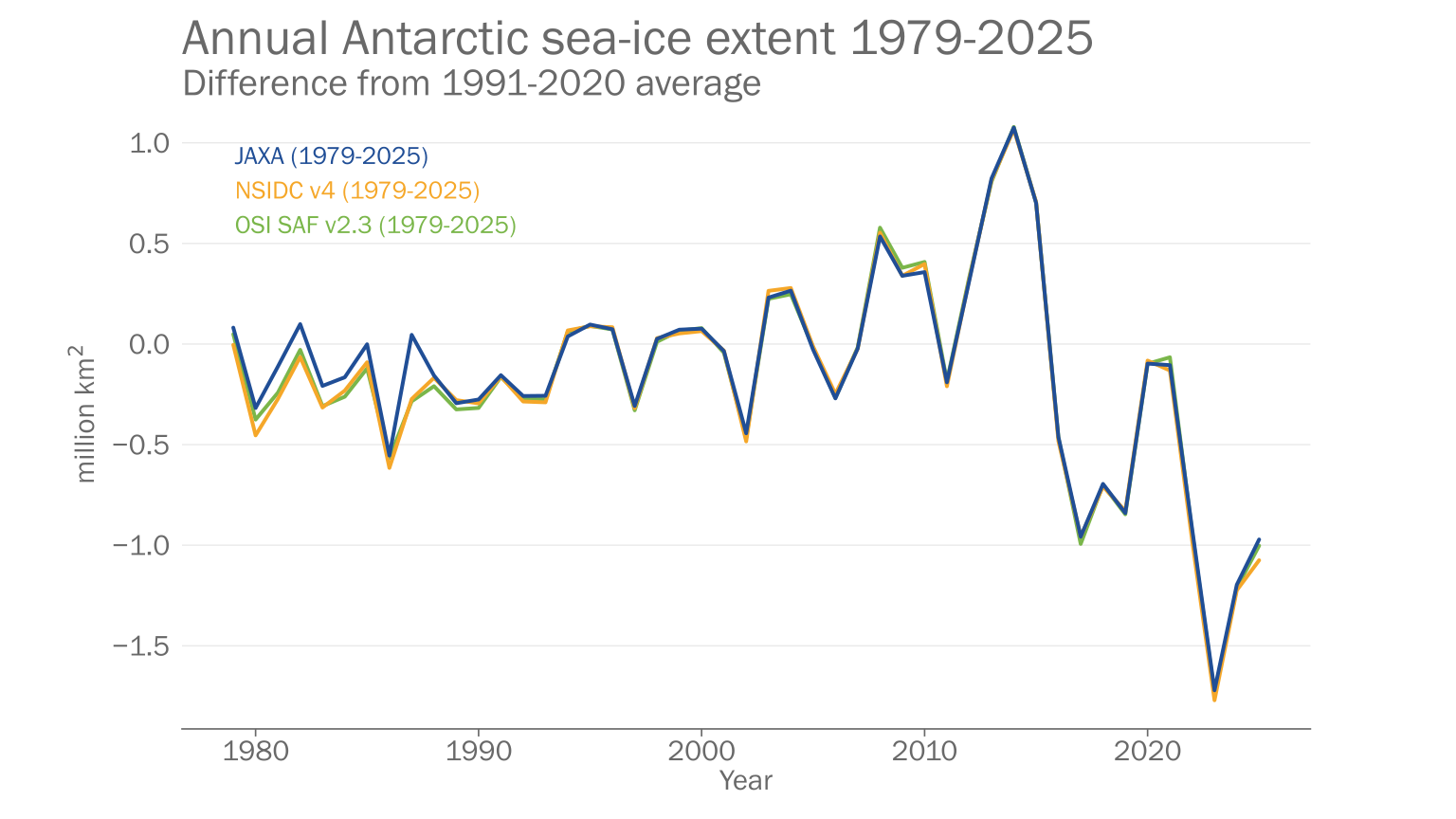
Annual Antarctic sea ice extent
Glaciers
Precipitation

Short-term Climate Drivers
Introduction
This page is a companion to the WMO State of the Global climate reports. It provides access to the latest versions of selected key global indicators used in the report.
Global climate indicators (for an overview see Trewin et al. 2021) provide a broad view of climate change at the largest scale, encompassing the composition of the atmosphere, energy changes, and the responses of the land, ocean, and ice. These indicators are closely related to one another. For example, the rise in CO2 and other greenhouse gases in the atmosphere leads to an imbalance of energy and thus warming of the atmosphere and ocean. Warming of the ocean in turn leads to rising sea levels, to which is added the melting of ice on land in response to increasing atmospheric temperatures.
The global indicators draw on a wide range of data sets, which are listed at the bottom of the page. Differences between data sets for the same indicator indicate the degree of uncertainty in the indicator. Figures are updated at least annually, with some data sets being updated more frequently.
Under each of the figures, you will find links to the images in multiple file formats (png, pdf and svg), as well as a set of data as shown in the figure in a common comma-separated values (csv) format. The "Read more" link will take you to a wider range of linked indicators.
What the IPCC says
Regarding the large-scale changes in the climate, Working Group 1 from the sixth assessment report of the Intergovernmental Panel on Climate Change concluded that:
A.1 It is unequivocal that human influence has warmed the atmosphere, ocean and land. Widespread and rapid changes in the atmosphere, ocean, cryosphere and biosphere have occurred.
A.2 The scale of recent changes across the climate system as a whole - and the present state of many aspects of the climate system - are unprecedented over many centuries to many thousands of years.
A.3 Human-induced climate change is already affecting many weather and climate extremes in every region across the globe. Evidence of observed changes in extremes such as heatwaves, heavy precipitation, droughts, and tropical cyclones, and, in particular, their attribution to human influence, has strengthened since AR5.
Key messages
Global mean temperature
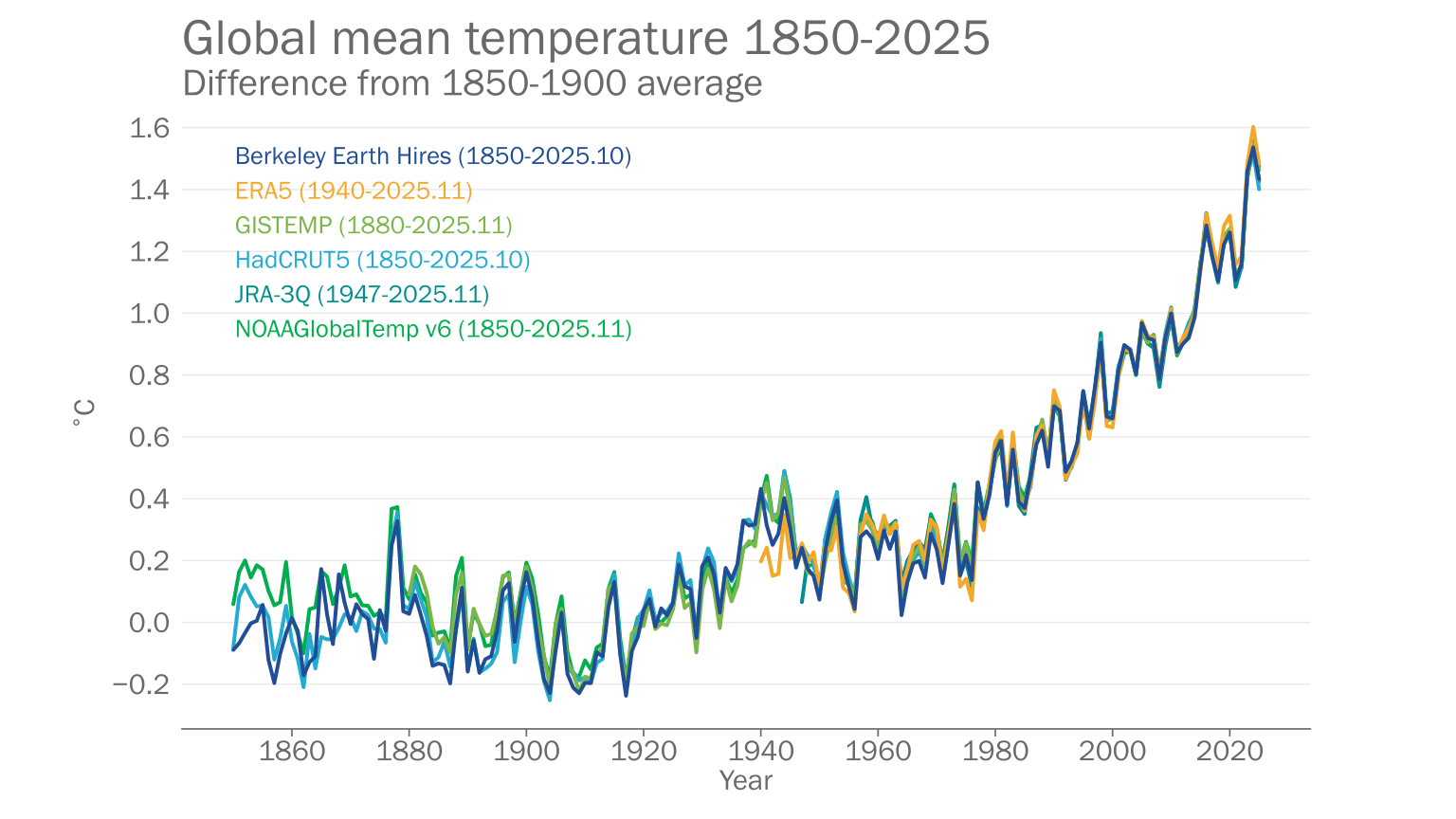
The year 2025 was ranked between the 2nd and 3rd warmest on record. The anomaly for 2025 was 1.43 [1.31 to 1.56]°C relative to the 1850-1900 average 9 data sets were used in this assessment: Berkeley Earth Hires, CMA-GMST, CMST, DCENT-I, ERA5, GISTEMP, HadCRUT5, JRA-3Q, and NOAAGlobalTemp v6.
Paragraph updated: 2026-03-17 14:18
Global mean sea level
The rate of change in the AVISO CNES data set is 3.47 mm/yr between 1993 and 2025. The rate of change in the past decade 2016-2025 is 4.02 mm/yr which is higher than the trend for the first decade of the satellite record 1993-2002 which was 2.14 mm/yr. The trend for 2015-2025 was 3.97 mm/yr.
Paragraph updated: 2026-03-17 14:18
Arctic sea-ice extent
Arctic sea ice extent in March 2025 was between 13.60 and 14.18million km2. This was the 1st lowest extent on record. In September the extent was between 4.69 and 5.24million km2. This was between the 11th and 13th lowest extent on record. Data sets used were: JAXA, NSIDC, NSIDC v4, OSI SAF v2.2, and OSI SAF v2.3
Paragraph updated: 2026-03-17 14:18
Dataset and processing details
Greenhouse gases
Carbon dioxide (CO2) is one of the most important greenhouse gases. The concentration of CO2 in the atmosphere is measured at stations around the world which are combined to provide a globally representative value.
The data in the above plot are available in a zip file containing a csv file for each data set.
Data file: Greenhouse_gases_data_files.zip
Checksum: fdbec44fc88d90303dd26f90e6cfeffe
Format: BADC CSV format
WDCGG
Original data file (external link)
Citation:
To produce the plot, the following processing steps were performed:
- Data set created from file ['co2_annual_20251016.csv'] downloaded from ['https://gaw.kishou.go.jp/static/publications/global_mean_mole_fractions/2025/co2_annual_20251016.csv'] at ['2025-10-17 10:10:39']
Earths Energy Imbalance
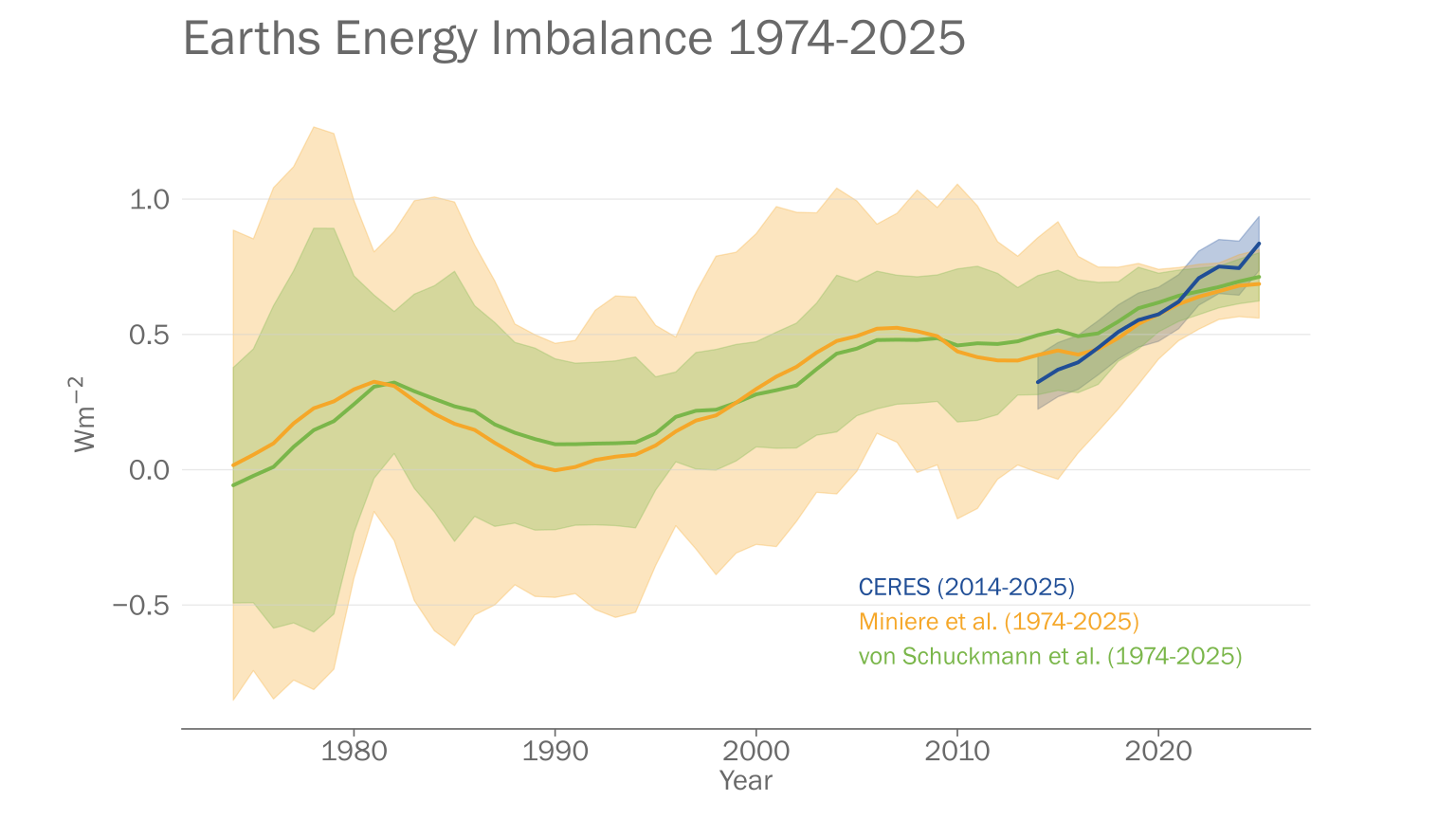
Earths energy imbalance is a measure of the net energy flux into the earth system. When the EEI is positive, the amount of energy entering the earth system is larger than the energy leaving the earth system and energy accumulates in the ocean, atmosphere, land and cryosphere, leading to warming. When the EEI is negative, the opposite happens.
The data in the above plot are available in a zip file containing a csv file for each data set.
Data file: Earths_Energy_Imbalance_data_files.zip
Checksum: 306b0a6a01e1512de155c240a3622dc5
Format: BADC CSV format
CERES
Original data file (external link)
Citation:
To produce the plot, the following processing steps were performed:
- Data set created from file ['EEI_timeseries.csv'] downloaded from [''] at ['2026-03-17 14:10:00']
Miniere et al.
Original data file (external link)
Citations:
- Minière, A., von Schuckmann, K., Sallée, JB. et al. Robust acceleration of Earth system heating observed over the past six decades. Sci Rep 13, 22975 (2023). https://doi.org/10.1038/s41598-023-49353-1.
- Ishii, M., Y. Fukuda, S. Hirahara, S. Yasui, T. Suzuki, and K. Sato. (2017). Accuracy of Global Upper Ocean Heat Content Estimation Expected from Present Observational Data Sets. SOLA 13 (0): 163–67. https://doi.org/10.2151/sola.2017-030.
- Lyman, J. M., & Johnson, G. C. (2023). Global High-Resolution Random Forest Regression Maps of Ocean Heat Content Anomalies Using In Situ and Satellite Data. Journal of Atmospheric and Oceanic Technology, 40(5), 575‑586. https://doi.org/10.1175/JTECH-D-22-0058.1.
- Cheng, Lijing, Kevin E. Trenberth, John Fasullo, Tim Boyer, John Abraham, and Jiang Zhu. (2017). Improved Estimates of Ocean Heat Content from 1960 to 2015. Science Advances 3 (3): e1601545. https://doi.org/10.1126/sciadv.1601545..
- Good, S.A., M.J. Martin, and N.A. Rayner. (2013). EN4: Quality Controlled Ocean Temperature and Salinity Profiles and Monthly Objective Analyses with Uncertainty Estimates. Journal of Geophysical Research: Oceans 118 (12): 6704–16. https://doi.org/10.1002/2013JC009067..
- Cheng, L., J. Zhu, R. Cowley, T. Boyer, and S. Wijffels. (2014). Time, Probe Type, and Temperature Variable Bias Corrections to Historical Expendable Bathythermograph Observations. Journal of Atmospheric and Oceanic Technology 31 (8): 1793–825. https://doi.org/10.1175/JTECH-D-13-00197.1..
- Gouretski, V., and F. Reseghetti. (2010). On Depth and Temperature Biases in Bathythermograph Data: Development of a New Correction Scheme Based on Analysis of a Global Ocean Database. Deep Sea Research Part I: Oceanographic Research Papers 57 (6): 812–33. https://doi.org/10.1016/j.dsr.2010.03.011..
- Levitus, S., J. I. Antonov, T. P. Boyer, R. A. Locarnini, H. E. Garcia, and A. V. Mishonov. (2009). Global Ocean Heat Content 1955–2008 in Light of Recently Revealed Instrumentation Problems. Geophysical Research Letters 36 (7): 2008GL037155. https://doi.org/10.1029/2008GL037155..
- Cowley, R., S. Wijffels, L. Cheng, T. Boyer, and S. Kizu. (2013). Biases in Expendable Bathythermograph Data: A New View Based on Historical Side-by-Side Comparisons. Journal of Atmospheric and Oceanic Technology 30 (6): 1195–225. https://doi.org/10.1175/JTECH-D-12-00127.1..
- Cabanes, C., A. Grouazel, K. Von Schuckmann, et al. (2013). The CORA Dataset: Validation and Diagnostics of in-Situ Ocean Temperature and Salinity Measurements. Ocean Science 9 (1): 1–18. https://doi.org/10.5194/os-9-1-2013..
- Szekely, T., Gourrion, J., Pouliquen, S., & Reverdin, G. (2025). CORA, Coriolis Ocean Dataset for Reanalysis. SEANOE. https://doi.org/10.17882/46219.
- Von Schuckmann, K., and P.-Y. Le Traon. (2011). How Well Can We Derive Global Ocean Indicators from Argo Data? Ocean Science 7 (6): 783–91. https://doi.org/10.5194/os-7-783-2011..
- Hosoda, S. (2007). Grid Point Value of the Monthly Objective Analysis Using the Argo Data. JAMSTEC. https://doi.org/10.17596/0000102..
- Hosoda, S., T. Ohira, and T. Nakamura. (2008). A Monthly Mean Dataset of Global Oceanic Temperature and Salinity Derived from Argo Float Observations. JAMSTEC Report of Research and Development 8 (0): 47–59. https://doi.org/10.5918/jamstecr.8.47..
- Li, H., F. Xu, W. Zhou, et al. (2017). Development of a Global Gridded Argo Data Set with Barnes Successive Corrections: A NEW GLOBAL GRIDDED ARGO DATA SET. Journal of Geophysical Research: Oceans 122 (2): 866–89. https://doi.org/10.1002/2016JC012285..
- Buongiorno Nardelli, Bruno. (2020). A Multi-Year Time Series of Observation-Based 3D Horizontal and Vertical Quasi-Geostrophic Global Ocean Currents. Earth System Science Data 12 (3): 1711–23. https://doi.org/10.5194/essd-12-1711-2020..
- Roemmich, D., and J. Gilson. 2009. The 2004–2008 Mean and Annual Cycle of Temperature, Salinity, and Steric Height in the Global Ocean from the Argo Program. Progress in Oceanography 82 (2): 81–100. https://doi.org/10.1016/j.pocean.2009.03.004.
- Levitus, S., J. I. Antonov, T. P. Boyer, et al. (2012). World Ocean Heat Content and Thermosteric Sea Level Change (0–2000 m), 1955–2010. Geophysical Research Letters 39 (10): 2012GL051106. https://doi.org/10.1029/2012GL051106..
- Zhang, C., D. Wang, Z. Liu, et al. (2022). Global Gridded Argo Dataset Based on Gradient-Dependent Optimal Interpolation. Journal of Marine Science and Engineering 10 (5): 650. https://doi.org/10.3390/jmse10050650..
To produce the plot, the following processing steps were performed:
- Data set created from file ['EEI_timeseries.csv'] downloaded from [''] at ['2026-03-17 14:09:51']
von Schuckmann et al.
Original data file (external link)
To produce the plot, the following processing steps were performed:
- Data set created from file ['EEI_timeseries.csv'] downloaded from [''] at ['2026-03-17 14:09:42']
Global temperature
Global mean temperature is based on measurements made at weather stations over land and by ships and buoys over the ocean. Temperatures are typically expressed as anomalies which are temperature differences from the average for a standard period. Here, 1850-1900 is used for the global mean. Instrumental temperature records are some of the longest climate records available, with some series extending back to the 17th century.
The data in the above plot are available in a zip file containing a csv file for each data set.
Data file: Global_temperature_data_files.zip
Checksum: 4a0c4044633a9b44145453c8fb83caf7
Format: BADC CSV format
Berkeley Earth Hires
Original data file (external link)
Citation:
To produce the plot, the following processing steps were performed:
- Data set created from file ['Global_TAVG_monthly.txt'] downloaded from ['https://storage.googleapis.com/berkeley-earth-temperature-hr/global/Global_TAVG_monthly.txt'] at ['2026-01-22 15:38:43']
- Rebaselined to 1981-2010 for each month separately by calculating the arithmetic mean of the data over the baseline period and subtracting the mean from all data values. This is done for each month separately (Januarys, Februarys etc).
- Calculated annual average from monthly averages using arithmetic mean
- Selected years within the range 1850 to 2025.
- Added offset of 0.69 to all data values.
- Manually changed baseline to 1850-1900. Note that data values remain unchanged.
CMA-GMST
Citation:
Data citation: https://data.cma.cn/en/#/Visualization/Visualization-detail?id=16
To produce the plot, the following processing steps were performed:
- Data set created from file ['CMA-GMST_Global_Month_Temp_1981_2010.csv'] downloaded from [] at ['2026-01-15 15:34:35']
- Rebaselined to 1981-2010 for each month separately by calculating the arithmetic mean of the data over the baseline period and subtracting the mean from all data values. This is done for each month separately (Januarys, Februarys etc).
- Calculated annual average from monthly averages using arithmetic mean
- Selected years within the range 1850 to 2025.
- Added offset of 0.69 to all data values.
- Manually changed baseline to 1850-1900. Note that data values remain unchanged.
CMST
Original data file (external link)
Citation:
To produce the plot, the following processing steps were performed:
- Data set created from file ['CMST_monthly.csv'] downloaded from ['http://www.gwpu.net/en/h-nd-166.html'] at ['2026-01-07 15:06:56']
- Rebaselined to 1981-2010 for each month separately by calculating the arithmetic mean of the data over the baseline period and subtracting the mean from all data values. This is done for each month separately (Januarys, Februarys etc).
- Calculated annual average from monthly averages using arithmetic mean
- Selected years within the range 1850 to 2025.
- Added offset of 0.69 to all data values.
- Manually changed baseline to 1850-1900. Note that data values remain unchanged.
DCENT-I
Original data file (external link)
Citations:
- Chan, D., Gebbie, G., Huybers, P. & Kent, E. C. DCENT: Dynamically Consistent ENsemble of Temperature at the Earth Surface. https://doi.org/10.7910/DVN/NU4UGW (2024)..
- Chan, D., Chan, S. C., Siddons, J. T., Cable, A., Cornes, R. C., Kent, E. C., Gebbie, G., & Huybers, P. DCENT-I: A Globally Infilled Extension of the Dynamically Consistent ENsemble of Temperature Dataset. https://doi.org/10.7910/DVN/ZY0WM8 (2025)..
- Chan D., Chan, S. C., Siddons, J. T., Cable, A., Cornes, R. C., Kent, E. C., Gebbie, G., & Huybers, P. (2025). DCENT-I: A Globally Infilled Extension of the Dynamically Consistent ENsemble of Temperature Dataset. Geoscience Data Journal..
To produce the plot, the following processing steps were performed:
- Data set created from file ['DCENT_DCENT_I_GMST_monthly_statistics_embargo.txt'] downloaded from ['https://dcent-i.github.io/'] at ['2026-01-22 15:58:19']
- Rebaselined to 1981-2010 for each month separately by calculating the arithmetic mean of the data over the baseline period and subtracting the mean from all data values. This is done for each month separately (Januarys, Februarys etc).
- Calculated annual average from monthly averages using arithmetic mean
- Selected years within the range 1850 to 2025.
- Added offset of 0.69 to all data values.
- Manually changed baseline to 1850-1900. Note that data values remain unchanged.
ERA5
Original data file (external link)
Citation:
Data citation: Hersbach, H., Bell, B., Berrisford, P., Biavati, G., Horányi, A., Muñoz Sabater, J., Nicolas, J., Peubey, C., Radu, R., Rozum, I., Schepers, D., Simmons, A., Soci, C., Dee, D., Thépaut, J-N. (2023): ERA5 monthly averaged data on single levels from 1940 to present. Copernicus Climate Change Service (C3S) Climate Data Store (CDS), DOI: 10.24381/cds.f17050d7 (Accessed on 2026-01-22 15:38:55)
Acknowledgement: Contains using Copernicus Climate Change Service information [2026]. Neither the European Commission nor ECMWF is responsible for any use that may be made of the Copernicus information or data it contains.
To produce the plot, the following processing steps were performed:
- Data set created from file ['C3S_Bulletin_temp_202512_Fig1b_timeseries_anomalies_ref1991-2020_global_allmonths_DATA.csv'] downloaded from ['https://climate.copernicus.eu/sites/default/files/2026-MMMM/C3S_Bulletin_temp_YLYLMLML_Fig1b_timeseries_anomalies_ref1991-2020_global_allmonths_DATA.csv'] at ['2026-01-22 15:38:55']
- Rebaselined to 1981-2010 for each month separately by calculating the arithmetic mean of the data over the baseline period and subtracting the mean from all data values. This is done for each month separately (Januarys, Februarys etc).
- Calculated annual average from monthly averages using arithmetic mean
- Selected years within the range 1850 to 2025.
- Added offset of 0.69 to all data values.
- Manually changed baseline to 1850-1900. Note that data values remain unchanged.
GISTEMP
Original data file (external link)
Citation:
Data citation: GISTEMP Team, 2022: GISS Surface Temperature Analysis (GISTEMP), version 4. NASA Goddard Institute for Space Studies. Dataset accessed 2026-01-22 15:39:23 at data.giss.nasa.gov/gistemp/.
To produce the plot, the following processing steps were performed:
- Data set created from file ['GLB.Ts+dSST.csv'] downloaded from ['https://data.giss.nasa.gov/gistemp/tabledata_v4/GLB.Ts+dSST.csv'] at ['2026-01-22 15:39:23']
- Rebaselined to 1981-2010 for each month separately by calculating the arithmetic mean of the data over the baseline period and subtracting the mean from all data values. This is done for each month separately (Januarys, Februarys etc).
- Calculated annual average from monthly averages using arithmetic mean
- Selected years within the range 1850 to 2025.
- Added offset of 0.69 to all data values.
- Manually changed baseline to 1850-1900. Note that data values remain unchanged.
HadCRUT5
Original data file (external link) Original data file (external link)
Citation:
Acknowledgement: HadCRUT.5.1.0.0 data were obtained from http://www.metoffice.gov.uk/hadobs/hadcrut5 on 2026-01-22 15:39:05 and are © British Crown Copyright, Met Office 2026, provided under an Open Government License, http://www.nationalarchives.gov.uk/doc/open-government-licence/version/3/
To produce the plot, the following processing steps were performed:
- Data set created from file ['HadCRUT.5.1.0.0.analysis.summary_series.global.monthly.csv', 'HadCRUT.5.1.0.0.analysis.summary_series.global.annual.csv'] downloaded from ['https://www.metoffice.gov.uk/hadobs/hadcrut5/data/HadCRUT.5.0.2.0/analysis/diagnostics/HadCRUT.5.1.0.0.analysis.summary_series.global.monthly.csv', 'https://www.metoffice.gov.uk/hadobs/hadcrut5/data/HadCRUT.5.0.2.0/analysis/diagnostics/HadCRUT.5.1.0.0.analysis.summary_series.global.annual.csv'] at ['2026-01-22 15:39:05', '2026-01-22 15:39:05']
- Rebaselined to 1981-2010 for each month separately by calculating the arithmetic mean of the data over the baseline period and subtracting the mean from all data values. This is done for each month separately (Januarys, Februarys etc).
- Calculated annual average from monthly averages using arithmetic mean
- Selected years within the range 1850 to 2025.
- Added offset of 0.69 to all data values.
- Manually changed baseline to 1850-1900. Note that data values remain unchanged.
JRA-3Q
Original data file (external link)
Citation:
Data citation: Japan Meteorological Agency. 2023, updated monthly. Japanese Reanalysis for Three Quarters of a Century (JRA-3Q). Research Data Archive at the National Center for Atmospheric Research, Computational and Information Systems Laboratory. https://doi.org/10.5065/AVTZ-1H78. Accessed 2026-03-09 16:24:44.
To produce the plot, the following processing steps were performed:
- Data set created from file ['JRA-3Q_tmp2m_global_ts_125_Clim9120.txt'] downloaded from [''] at ['2026-03-09 16:24:44']
- Rebaselined to 1981-2010 for each month separately by calculating the arithmetic mean of the data over the baseline period and subtracting the mean from all data values. This is done for each month separately (Januarys, Februarys etc).
- Calculated annual average from monthly averages using arithmetic mean
- Selected years within the range 1850 to 2025.
- Added offset of 0.69 to all data values.
- Manually changed baseline to 1850-1900. Note that data values remain unchanged.
NOAAGlobalTemp v6
Original data file (external link) Original data file (external link)
Citation:
Data citation: Huang, Boyin; Yin, Xungang; Menne, Matthew J.; Vose, Russell S.; and Zhang, Huai-Min. 2024. NOAA Global Surface Temperature Dataset (NOAAGlobalTemp), Version 6.0.. NOAA National Centers for Environmental Information. https://doi.org/10.25921/rzxg-p717. Accessed 2026-01-22 15:39:10.
To produce the plot, the following processing steps were performed:
- Data set created from file ['aravg.mon.land_ocean.90S.90N.v6.0.0.202512.asc', 'aravg.ann.land_ocean.90S.90N.*.asc'] downloaded from ['https://www.ncei.noaa.gov/data/noaa-global-surface-temperature/v6/access/timeseries/aravg.mon.land_ocean.90S.90N.v6.0.0.202512.asc', 'https://www.ncei.noaa.gov/data/noaa-global-surface-temperature/v6/access/timeseries/aravg.ann.land_ocean.90S.90N.*.asc'] at ['2026-01-22 15:39:10']
- Rebaselined to 1981-2010 for each month separately by calculating the arithmetic mean of the data over the baseline period and subtracting the mean from all data values. This is done for each month separately (Januarys, Februarys etc).
- Calculated annual average from monthly averages using arithmetic mean
- Selected years within the range 1850 to 2025.
- Added offset of 0.69 to all data values.
- Manually changed baseline to 1850-1900. Note that data values remain unchanged.
Ocean Indicators
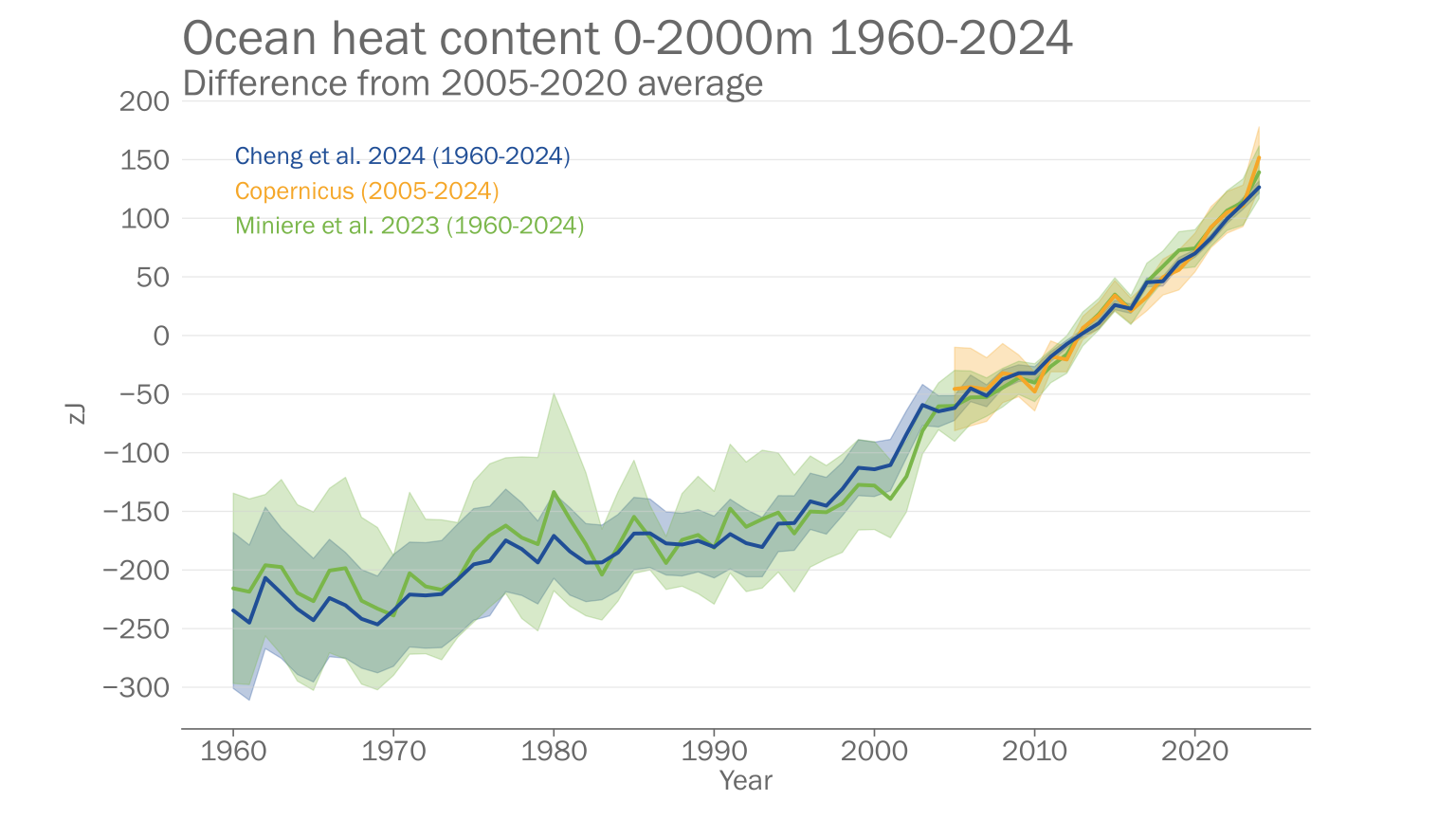
The data in the above plot are available in a zip file containing a csv file for each data set.
Data file: Ocean_Indicators_data_files.zip
Checksum: f9a7766796534b1d8ee5c26875f93984
Format: BADC CSV format
Cheng et al
Original data file (external link)
Citation:
To produce the plot, the following processing steps were performed:
- Data set created from file ['IAPv4.2_OHC_estimate_update.txt'] downloaded from ['http://www.ocean.iap.ac.cn/ftp/images_files/IAPv4.2_OHC_estimate_update.txt'] at ['2026-01-14 13:47:43']
- Calculated annual average from monthly averages using arithmetic mean
- Rebaselined to 2005-2025 by subtracting the arithemtic mean for that period from all data values.
- Selected years within the range 1960 to 2025.
Copernicus
Original data file (external link)
To produce the plot, the following processing steps were performed:
- Data set created from file ['OHC_area_averaged_anomalies_wmo_glo_19602025_lat60-60_0-2000_R20052024_yearly_jm2_P20260203_new.nc'] downloaded from [''] at ['2026-02-03 17:39:04']
- Rebaselined to 2005-2025 by subtracting the arithemtic mean for that period from all data values.
- Selected years within the range 1960 to 2025.
von Schuckmann et al.
Original data file (external link)
Citations:
- von Schuckmann, K. et al. (2020) Heat stored in the Earth system: where does the energy go?, Earth Syst. Sci. Data, 12, 2013–2041, https://doi.org/10.5194/essd-12-2013-2020, 2020..
- Ishii, M., Y. Fukuda, S. Hirahara, S. Yasui, T. Suzuki, and K. Sato. (2017). Accuracy of Global Upper Ocean Heat Content Estimation Expected from Present Observational Data Sets. SOLA 13 (0): 163–67. https://doi.org/10.2151/sola.2017-030..
- Lyman, J.M., and G.C. Johnson. (2014). Estimating Global Ocean Heat Content Changes in the Upper 1800 m since 1950 and the Influence of Climatology Choice. Journal of Climate 27 (5): 1945–57. https://doi.org/10.1175/JCLI-D-12-00752.1..
- Desbruyères, D., E.L. McDonagh, B.A. King, and V. Thierry. (2017). Global and Full-Depth Ocean Temperature Trends during the Early Twenty-First Century from Argo and Repeat Hydrography. Journal of Climate 30 (6): 1985–97. https://doi.org/10.1175/JCLI-D-16-0396.1..
- Cheng, Lijing, Kevin E. Trenberth, John Fasullo, Tim Boyer, John Abraham, and Jiang Zhu. (2017). Improved Estimates of Ocean Heat Content from 1960 to 2015. Science Advances 3 (3): e1601545. https://doi.org/10.1126/sciadv.1601545..
- Roemmich, D., and J. Gilson. 2009. The 2004–2008 Mean and Annual Cycle of Temperature, Salinity, and Steric Height in the Global Ocean from the Argo Program. Progress in Oceanography 82 (2): 81–100. https://doi.org/10.1016/j.pocean.2009.03.004..
- Good, S.A., M.J. Martin, and N.A. Rayner. (2013). EN4: Quality Controlled Ocean Temperature and Salinity Profiles and Monthly Objective Analyses with Uncertainty Estimates. Journal of Geophysical Research: Oceans 118 (12): 6704–16. https://doi.org/10.1002/2013JC009067..
- Cabanes, C., A. Grouazel, K. Von Schuckmann, et al. (2013). The CORA Dataset: Validation and Diagnostics of in-Situ Ocean Temperature and Salinity Measurements. Ocean Science 9 (1): 1–18. https://doi.org/10.5194/os-9-1-2013..
- Von Schuckmann, K., and P.-Y. Le Traon. (2011). How Well Can We Derive Global Ocean Indicators from Argo Data? Ocean Science 7 (6): 783–91. https://doi.org/10.5194/os-7-783-2011..
- Giglio, D., T. Sukianto, M. Kuusela, and B.K.-A. Mills. (2026). Global Ocean Heat Content Anomalies and Ocean Heat Uptake Based on Mapping Argo Data Using Local Gaussian Processes. Version 4.0.1. Zenodo, February 1. https://doi.org/10.5281/ZENODO.18187866..
- Hosoda, S. (2007). Grid Point Value of the Monthly Objective Analysis Using the Argo Data. JAMSTEC. https://doi.org/10.17596/0000102..
- Hosoda, S., T. Ohira, and T. Nakamura. (2008). A Monthly Mean Dataset of Global Oceanic Temperature and Salinity Derived from Argo Float Observations. JAMSTEC Report of Research and Development 8 (0): 47–59. https://doi.org/10.5918/jamstecr.8.47..
- Li, H., F. Xu, W. Zhou, et al. (2017). Development of a Global Gridded Argo Data Set with Barnes Successive Corrections: A NEW GLOBAL GRIDDED ARGO DATA SET. Journal of Geophysical Research: Oceans 122 (2): 866–89. https://doi.org/10.1002/2016JC012285..
- Domingues, C.M., J.A. Church, N.J. White, et al. (2008). Improved Estimates of Upper-Ocean Warming and Multi-Decadal Sea-Level Rise. Nature 453 (7198): 1090–93. https://doi.org/10.1038/nature07080..
- Church, J.A., N. J. White, L.F. Konikow, et al. (2011). Revisiting the Earths Sea-Level and Energy Budgets from 1961 to 2008: SEA-LEVEL AND ENERGY BUDGETS. Geophysical Research Letters 38 (18): https://doi.org/10.1029/2011GL048794..
- Levitus, S., J. I. Antonov, T. P. Boyer, et al. (2012). World Ocean Heat Content and Thermosteric Sea Level Change (0–2000 m), 1955–2010. Geophysical Research Letters 39 (10): 2012GL051106. https://doi.org/10.1029/2012GL051106..
- Johnson, G.C., and S.G. Purkey. (2024). Refined Estimates of Global Ocean Deep and Abyssal Decadal Warming Trends. Geophysical Research Letters 51 (18): e2024GL111229. https://doi.org/10.1029/2024GL111229..
Notes: The GCOS dataset is an ensemble dataset comprising several individual datasets.
To produce the plot, the following processing steps were performed:
- Data set created from file ['OHC_area_averaged_anomalies_wmo_glo_19602025_lat60-60_0-2000_R20052024_yearly_jm2_P20260203_new.nc'] downloaded from [''] at ['2026-02-03 17:39:19']
- Rebaselined to 2005-2025 by subtracting the arithemtic mean for that period from all data values.
- Selected years within the range 1960 to 2025.
Miniere et al. 2023
Original data file (external link)
Citations:
- Minière, A., von Schuckmann, K., Sallée, JB. et al. Robust acceleration of Earth system heating observed over the past six decades. Sci Rep 13, 22975 (2023). https://doi.org/10.1038/s41598-023-49353-1.
- Ishii, M., Y. Fukuda, S. Hirahara, S. Yasui, T. Suzuki, and K. Sato. (2017). Accuracy of Global Upper Ocean Heat Content Estimation Expected from Present Observational Data Sets. SOLA 13 (0): 163–67. https://doi.org/10.2151/sola.2017-030.
- Lyman, J. M., & Johnson, G. C. (2023). Global High-Resolution Random Forest Regression Maps of Ocean Heat Content Anomalies Using In Situ and Satellite Data. Journal of Atmospheric and Oceanic Technology, 40(5), 575‑586. https://doi.org/10.1175/JTECH-D-22-0058.1.
- Cheng, Lijing, Kevin E. Trenberth, John Fasullo, Tim Boyer, John Abraham, and Jiang Zhu. (2017). Improved Estimates of Ocean Heat Content from 1960 to 2015. Science Advances 3 (3): e1601545. https://doi.org/10.1126/sciadv.1601545..
- Good, S.A., M.J. Martin, and N.A. Rayner. (2013). EN4: Quality Controlled Ocean Temperature and Salinity Profiles and Monthly Objective Analyses with Uncertainty Estimates. Journal of Geophysical Research: Oceans 118 (12): 6704–16. https://doi.org/10.1002/2013JC009067..
- Cheng, L., J. Zhu, R. Cowley, T. Boyer, and S. Wijffels. (2014). Time, Probe Type, and Temperature Variable Bias Corrections to Historical Expendable Bathythermograph Observations. Journal of Atmospheric and Oceanic Technology 31 (8): 1793–825. https://doi.org/10.1175/JTECH-D-13-00197.1..
- Gouretski, V., and F. Reseghetti. (2010). On Depth and Temperature Biases in Bathythermograph Data: Development of a New Correction Scheme Based on Analysis of a Global Ocean Database. Deep Sea Research Part I: Oceanographic Research Papers 57 (6): 812–33. https://doi.org/10.1016/j.dsr.2010.03.011..
- Levitus, S., J. I. Antonov, T. P. Boyer, R. A. Locarnini, H. E. Garcia, and A. V. Mishonov. (2009). Global Ocean Heat Content 1955–2008 in Light of Recently Revealed Instrumentation Problems. Geophysical Research Letters 36 (7): 2008GL037155. https://doi.org/10.1029/2008GL037155..
- Cowley, R., S. Wijffels, L. Cheng, T. Boyer, and S. Kizu. (2013). Biases in Expendable Bathythermograph Data: A New View Based on Historical Side-by-Side Comparisons. Journal of Atmospheric and Oceanic Technology 30 (6): 1195–225. https://doi.org/10.1175/JTECH-D-12-00127.1..
- Cabanes, C., A. Grouazel, K. Von Schuckmann, et al. (2013). The CORA Dataset: Validation and Diagnostics of in-Situ Ocean Temperature and Salinity Measurements. Ocean Science 9 (1): 1–18. https://doi.org/10.5194/os-9-1-2013..
- Szekely, T., Gourrion, J., Pouliquen, S., & Reverdin, G. (2025). CORA, Coriolis Ocean Dataset for Reanalysis. SEANOE. https://doi.org/10.17882/46219.
- Von Schuckmann, K., and P.-Y. Le Traon. (2011). How Well Can We Derive Global Ocean Indicators from Argo Data? Ocean Science 7 (6): 783–91. https://doi.org/10.5194/os-7-783-2011..
- Hosoda, S. (2007). Grid Point Value of the Monthly Objective Analysis Using the Argo Data. JAMSTEC. https://doi.org/10.17596/0000102..
- Hosoda, S., T. Ohira, and T. Nakamura. (2008). A Monthly Mean Dataset of Global Oceanic Temperature and Salinity Derived from Argo Float Observations. JAMSTEC Report of Research and Development 8 (0): 47–59. https://doi.org/10.5918/jamstecr.8.47..
- Li, H., F. Xu, W. Zhou, et al. (2017). Development of a Global Gridded Argo Data Set with Barnes Successive Corrections: A NEW GLOBAL GRIDDED ARGO DATA SET. Journal of Geophysical Research: Oceans 122 (2): 866–89. https://doi.org/10.1002/2016JC012285..
- Buongiorno Nardelli, Bruno. (2020). A Multi-Year Time Series of Observation-Based 3D Horizontal and Vertical Quasi-Geostrophic Global Ocean Currents. Earth System Science Data 12 (3): 1711–23. https://doi.org/10.5194/essd-12-1711-2020..
- Roemmich, D., and J. Gilson. 2009. The 2004–2008 Mean and Annual Cycle of Temperature, Salinity, and Steric Height in the Global Ocean from the Argo Program. Progress in Oceanography 82 (2): 81–100. https://doi.org/10.1016/j.pocean.2009.03.004.
- Levitus, S., J. I. Antonov, T. P. Boyer, et al. (2012). World Ocean Heat Content and Thermosteric Sea Level Change (0–2000 m), 1955–2010. Geophysical Research Letters 39 (10): 2012GL051106. https://doi.org/10.1029/2012GL051106..
- Zhang, C., D. Wang, Z. Liu, et al. (2022). Global Gridded Argo Dataset Based on Gradient-Dependent Optimal Interpolation. Journal of Marine Science and Engineering 10 (5): 650. https://doi.org/10.3390/jmse10050650..
Notes: The Miniere et al. dataset is an ensemble dataset comprising several individual datasets.
To produce the plot, the following processing steps were performed:
- Data set created from file ['OHC_area_averaged_anomalies_wmo_glo_19602025_lat60-60_0-2000_R20052024_yearly_jm2_P20260203_new.nc'] downloaded from [''] at ['2026-02-03 17:39:31']
- Rebaselined to 2005-2025 by subtracting the arithemtic mean for that period from all data values.
- Selected years within the range 1960 to 2025.
Global mean sea level
Global mean sea level is a measured by satellites using radar altimeters that record the time taken for a radar signal to reach the sea-surface and return to the satellite. Longer records of sea level (not shown here) exist based on tide gauge measurements made along coastlines around the world since the late 19th century.
The data in the above plot are available in a zip file containing a csv file for each data set.
Data file: Global_mean_sea_level_data_files.zip
Checksum: 7fb189d493934d8eb1718652b6998660
Format: BADC CSV format
AVISO CNES
Original data file (external link)
Citation:
Acknowledgement: Generated using AVISO+ Products
To produce the plot, the following processing steps were performed:
- Data set created from file ['MSL_Serie_MERGED_Global_AVISO_GIA_Adjust_Filter2m_NRT.nc'] downloaded from ['ftp://ftp.aviso.altimetry.fr/pub/oceano/AVISO/indicators/msl/MSL_Serie_MERGED_Global_AVISO_GIA_Adjust_Filter2m_NRT.nc'] at ['2026-02-25 10:07:46']
- Filtered with a 9-point Savgol filter of order 1
- Zeroed at first time step of 2000.
- Added offset of -18.393374999123978 to all data values.
- Selected years within the range 1993 to 2025.
Ocean surface pH
Ocean pH is a measure of how acid/alkaline the ocean surface water is. The ocean surface is typically slightly alkaline, however, increasing concentration of CO2 in the water is driving a decline in pH known as ocean acidification.
The data in the above plot are available in a zip file containing a csv file for each data set.
Data file: Ocean_surface_pH_data_files.zip
Checksum: 714bdb79d74b0c359e0c96d3fd67f656
Format: BADC CSV format
CMEMS
Original data file (external link)
Citation:
Data citation: https://doi.org/10.48670/moi-00224
To produce the plot, the following processing steps were performed:
- Data set created from file ['ph_time_serie_1985_2025_mean_std.txt'] downloaded from [''] at ['2026-01-19 15:44:37']
Annual Arctic sea ice extent
Sea-ice concentrations are estimated from microwave radiances measured from satellites (from 1979). Sea-ice extent is calculated as the area of ocean grid cells where the sea-ice concentration exceeds 15%. Although there are relatively large differences in the absolute extent between data sets, they agree well on the year-to-year changes and the trends.
The data in the above plot are available in a zip file containing a csv file for each data set.
Data file: Annual_Arctic_sea_ice_extent_data_files.zip
Checksum: 65506e5736df8262ecc990959f27ec24
Format: BADC CSV format
JAXA
Original data file (external link)
To produce the plot, the following processing steps were performed:
- Data set created from file ['JASMES_CLIMATE_SIE_5DAVG_PS_NHM.txt'] downloaded from ['ftp://apollo.eorc.jaxa.jp/pub/JASMES/Polar_XXkm/sie/'] at ['2026-01-05 11:06:50']
- Calculated monthly average from values using arithmetic mean of all dates that fall within each month
- Selected years within the range 1979 to 2025.
- Rebaselined to 1991-2020 for each month separately by calculating the arithmetic mean of the data over the baseline period and subtracting the mean from all data values. This is done for each month separately (Januarys, Februarys etc).
- Calculated annual average from monthly averages using arithmetic mean
NSIDC v4
Original data file (external link) Original data file (external link) Original data file (external link) Original data file (external link) Original data file (external link) Original data file (external link) Original data file (external link) Original data file (external link) Original data file (external link) Original data file (external link) Original data file (external link) Original data file (external link)
Data citation: Fetterer, F., K. Knowles, W. N. Meier, M. Savoie, and A. K. Windnagel. 2017, updated daily. Sea Ice Index, Version 3. 1979-present. Boulder, Colorado USA. NSIDC: National Snow and Ice Data Center. doi: https://doi.org/10.7265/N5K072F8. [2026-01-22 15:42:10].
Acknowledgement: Fetterer, F., K. Knowles, W. N. Meier, M. Savoie, and A. K. Windnagel. 2017, updated daily. Sea Ice Index, Version 3. 1979-present. Boulder, Colorado USA. NSIDC: National Snow and Ice Data Center. doi: https://doi.org/10.7265/N5K072F8. [2026-01-22 15:42:10].
To produce the plot, the following processing steps were performed:
- Data set created from file ['N_01_extent_v4.0.csv', 'N_02_extent_v4.0.csv', 'N_03_extent_v4.0.csv', 'N_04_extent_v4.0.csv', 'N_05_extent_v4.0.csv', 'N_06_extent_v4.0.csv', 'N_07_extent_v4.0.csv', 'N_08_extent_v4.0.csv', 'N_09_extent_v4.0.csv', 'N_10_extent_v4.0.csv', 'N_11_extent_v4.0.csv', 'N_12_extent_v4.0.csv'] downloaded from ['ftp://sidads.colorado.edu/DATASETS/NOAA/G02135/north/monthly/data/N_01_extent_v4.0.csv', 'ftp://sidads.colorado.edu/DATASETS/NOAA/G02135/north/monthly/data/N_02_extent_v4.0.csv', 'ftp://sidads.colorado.edu/DATASETS/NOAA/G02135/north/monthly/data/N_03_extent_v4.0.csv', 'ftp://sidads.colorado.edu/DATASETS/NOAA/G02135/north/monthly/data/N_04_extent_v4.0.csv', 'ftp://sidads.colorado.edu/DATASETS/NOAA/G02135/north/monthly/data/N_05_extent_v4.0.csv', 'ftp://sidads.colorado.edu/DATASETS/NOAA/G02135/north/monthly/data/N_06_extent_v4.0.csv', 'ftp://sidads.colorado.edu/DATASETS/NOAA/G02135/north/monthly/data/N_07_extent_v4.0.csv', 'ftp://sidads.colorado.edu/DATASETS/NOAA/G02135/north/monthly/data/N_08_extent_v4.0.csv', 'ftp://sidads.colorado.edu/DATASETS/NOAA/G02135/north/monthly/data/N_09_extent_v4.0.csv', 'ftp://sidads.colorado.edu/DATASETS/NOAA/G02135/north/monthly/data/N_10_extent_v4.0.csv', 'ftp://sidads.colorado.edu/DATASETS/NOAA/G02135/north/monthly/data/N_11_extent_v4.0.csv', 'ftp://sidads.colorado.edu/DATASETS/NOAA/G02135/north/monthly/data/N_12_extent_v4.0.csv'] at ['2026-01-22 15:42:10', '2026-01-22 15:42:12', '2026-01-22 15:42:13', '2026-01-22 15:42:14', '2026-01-22 15:42:15', '2026-01-22 15:42:16', '2026-01-22 15:42:17', '2026-01-22 15:42:18', '2026-01-22 15:42:19', '2026-01-22 15:42:20', '2026-01-22 15:42:22', '2026-01-22 15:42:23']
- Selected years within the range 1979 to 2025.
- Rebaselined to 1991-2020 for each month separately by calculating the arithmetic mean of the data over the baseline period and subtracting the mean from all data values. This is done for each month separately (Januarys, Februarys etc).
- Calculated annual average from monthly averages using arithmetic mean
OSI SAF v2.3
Original data file (external link)
Citation:
Data citation: EUMETSAT Ocean and Sea Ice Satellite Application Facility, Sea ice index 1979-onwards (v2.2, 2023), OSI-420, Data extracted from OSI SAF FTP server: 1979-present, Northern Hemisphere, accessed 2026-01-22 15:42:23
Acknowledgement: The OSI SAF Sea Ice Index v2.2 is made available at https://osisaf-hl.met.no/v2p2-sea-ice-index. The OSI SAF Sea Ice Index v2p1 is prepared using EUMETSAT OSI SAF Sea Ice Concentration data, with R&D input from the ESA Climate Change Initiative (ESA CCI) (Lavergne et al. 2019)
To produce the plot, the following processing steps were performed:
- Data set created from file ['osisaf_nh_sie_monthly.txt'] downloaded from ['ftp://osisaf.met.no/prod_test/ice/index/v2p3/nh/osisaf_nh_sie_monthly.txt'] at ['2026-01-22 15:42:23']
- Selected years within the range 1979 to 2025.
- Rebaselined to 1991-2020 for each month separately by calculating the arithmetic mean of the data over the baseline period and subtracting the mean from all data values. This is done for each month separately (Januarys, Februarys etc).
- Calculated annual average from monthly averages using arithmetic mean
Annual Antarctic sea ice extent
Sea-ice concentrations are estimated from microwave radiances measured from satellites (from 1979). Sea-ice extent is calculated as the area of ocean grid cells where the sea-ice concentration exceeds 15%. Although there are relatively large differences in the absolute extent between data sets, they agree well on the year-to-year changes and the trends.
The data in the above plot are available in a zip file containing a csv file for each data set.
Data file: Annual_Antarctic_sea_ice_extent_data_files.zip
Checksum: dbc19592d60ef365a384eb192418c75c
Format: BADC CSV format
JAXA
Original data file (external link)
To produce the plot, the following processing steps were performed:
- Data set created from file ['JASMES_CLIMATE_SIE_5DAVG_PS_SHM.txt'] downloaded from ['ftp://apollo.eorc.jaxa.jp/pub/JASMES/Polar_XXkm/sie/'] at ['2026-01-05 11:07:20']
- Calculated monthly average from values using arithmetic mean of all dates that fall within each month
- Selected years within the range 1979 to 2025.
- Rebaselined to 1991-2020 for each month separately by calculating the arithmetic mean of the data over the baseline period and subtracting the mean from all data values. This is done for each month separately (Januarys, Februarys etc).
- Calculated annual average from monthly averages using arithmetic mean
NSIDC v4
Original data file (external link) Original data file (external link) Original data file (external link) Original data file (external link) Original data file (external link) Original data file (external link) Original data file (external link) Original data file (external link) Original data file (external link) Original data file (external link) Original data file (external link) Original data file (external link)
Data citation: Fetterer, F., K. Knowles, W. N. Meier, M. Savoie, and A. K. Windnagel. 2017, updated daily. Sea Ice Index, Version 3. 1979-present. Boulder, Colorado USA. NSIDC: National Snow and Ice Data Center. doi: https://doi.org/10.7265/N5K072F8. [2026-01-22 15:42:24].
Acknowledgement: Fetterer, F., K. Knowles, W. N. Meier, M. Savoie, and A. K. Windnagel. 2017, updated daily. Sea Ice Index, Version 3. 1979-present. Boulder, Colorado USA. NSIDC: National Snow and Ice Data Center. doi: https://doi.org/10.7265/N5K072F8. [2026-01-22 15:42:24].
To produce the plot, the following processing steps were performed:
- Data set created from file ['S_01_extent_v4.0.csv', 'S_02_extent_v4.0.csv', 'S_03_extent_v4.0.csv', 'S_04_extent_v4.0.csv', 'S_05_extent_v4.0.csv', 'S_06_extent_v4.0.csv', 'S_07_extent_v4.0.csv', 'S_08_extent_v4.0.csv', 'S_09_extent_v4.0.csv', 'S_10_extent_v4.0.csv', 'S_11_extent_v4.0.csv', 'S_12_extent_v4.0.csv'] downloaded from ['ftp://sidads.colorado.edu/DATASETS/NOAA/G02135/south/monthly/data/S_01_extent_v4.0.csv', 'ftp://sidads.colorado.edu/DATASETS/NOAA/G02135/south/monthly/data/S_02_extent_v4.0.csv', 'ftp://sidads.colorado.edu/DATASETS/NOAA/G02135/south/monthly/data/S_03_extent_v4.0.csv', 'ftp://sidads.colorado.edu/DATASETS/NOAA/G02135/south/monthly/data/S_04_extent_v4.0.csv', 'ftp://sidads.colorado.edu/DATASETS/NOAA/G02135/south/monthly/data/S_05_extent_v4.0.csv', 'ftp://sidads.colorado.edu/DATASETS/NOAA/G02135/south/monthly/data/S_06_extent_v4.0.csv', 'ftp://sidads.colorado.edu/DATASETS/NOAA/G02135/south/monthly/data/S_07_extent_v4.0.csv', 'ftp://sidads.colorado.edu/DATASETS/NOAA/G02135/south/monthly/data/S_08_extent_v4.0.csv', 'ftp://sidads.colorado.edu/DATASETS/NOAA/G02135/south/monthly/data/S_09_extent_v4.0.csv', 'ftp://sidads.colorado.edu/DATASETS/NOAA/G02135/south/monthly/data/S_10_extent_v4.0.csv', 'ftp://sidads.colorado.edu/DATASETS/NOAA/G02135/south/monthly/data/S_11_extent_v4.0.csv', 'ftp://sidads.colorado.edu/DATASETS/NOAA/G02135/south/monthly/data/S_12_extent_v4.0.csv'] at ['2026-01-22 15:42:24', '2026-01-22 15:42:25', '2026-01-22 15:42:27', '2026-01-22 15:42:28', '2026-01-22 15:42:29', '2026-01-22 15:42:30', '2026-01-22 15:42:31', '2026-01-22 15:42:32', '2026-01-22 15:42:33', '2026-01-22 15:42:34', '2026-01-22 15:42:36', '2026-01-22 15:42:37']
- Selected years within the range 1979 to 2025.
- Rebaselined to 1991-2020 for each month separately by calculating the arithmetic mean of the data over the baseline period and subtracting the mean from all data values. This is done for each month separately (Januarys, Februarys etc).
- Calculated annual average from monthly averages using arithmetic mean
OSI SAF v2.3
Original data file (external link)
Citation:
Data citation: EUMETSAT Ocean and Sea Ice Satellite Application Facility, Sea ice index 1979-onwards (v2.1, 2020), OSI-420, Data extracted from OSI SAF FTP server: 1979-present, Northern Hemisphere, accessed 2026-01-22 15:42:37
Acknowledgement: The OSI SAF Sea Ice Index v2.1 is made available at https://osisaf-hl.met.no/v2p1-sea-ice-index. The OSI SAF Sea Ice Index v2p1 is prepared using EUMETSAT OSI SAF Sea Ice Concentration data, with R&D input from the ESA Climate Change Initiative (ESA CCI) (Lavergne et al. 2019)
To produce the plot, the following processing steps were performed:
- Data set created from file ['osisaf_sh_sie_monthly.txt'] downloaded from ['ftp://osisaf.met.no/prod_test/ice/index/v2p3/sh/osisaf_sh_sie_monthly.txt'] at ['2026-01-22 15:42:37']
- Selected years within the range 1979 to 2025.
- Rebaselined to 1991-2020 for each month separately by calculating the arithmetic mean of the data over the baseline period and subtracting the mean from all data values. This is done for each month separately (Januarys, Februarys etc).
- Calculated annual average from monthly averages using arithmetic mean
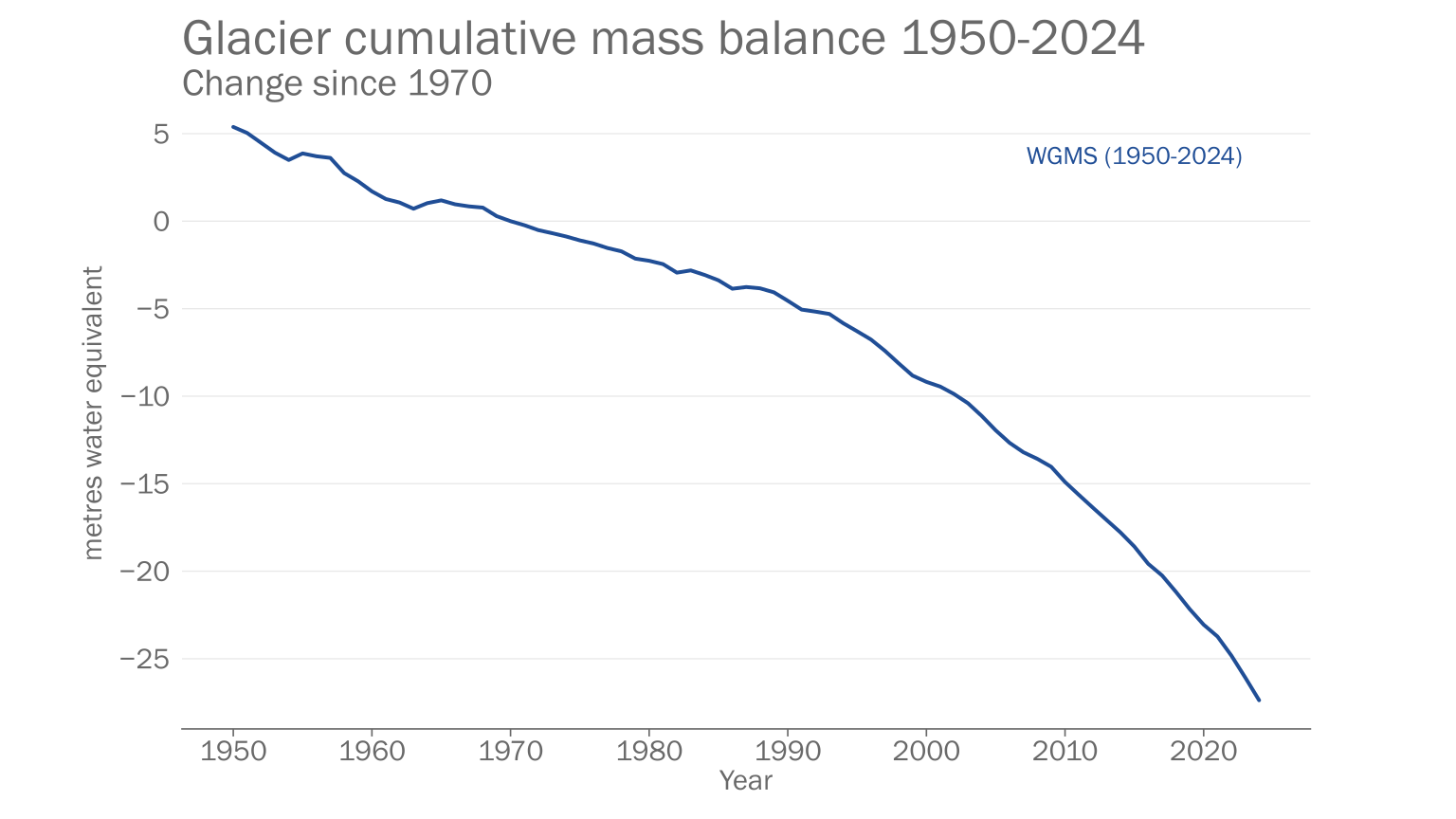
Glaciers
Glaciers are measured using a variety of different techniques. Glacier mass balance data for the global network of reference glaciers are available from the World Glacier Monitoring Service (WGMS), https://www.wgms.ch.
The data in the above plot are available in a zip file containing a csv file for each data set.
Data file: Glaciers_data_files.zip
Checksum: 8413a53e1e54e36a1ef1734c1a47884a
Format: BADC CSV format
WGMS
Original data file (external link)
Citation:
Data citation: WGMS (2017, updated, and earlier reports): Global Glacier Change Bulletin No. 2 (2014-2015). Zemp, M., Nussbaumer, S. U., Gärtner-Roer, I., Huber, J., Machguth, H., Paul, F., and Hoelzle, M. (eds.), ICSU(WDS)/IUGG(IACS)/UNEP/UNESCO/WMO, World Glacier Monitoring Service, Zurich, Switzerland, 244 pp., based on database version: doi:10.5904/wgms-fog-2018-11.
To produce the plot, the following processing steps were performed:
- Data set created from file ['mb_ref.csv'] downloaded from ['http://wgms.ch/data/faq/mb_ref.csv'] at ['2026-02-25 10:15:25']
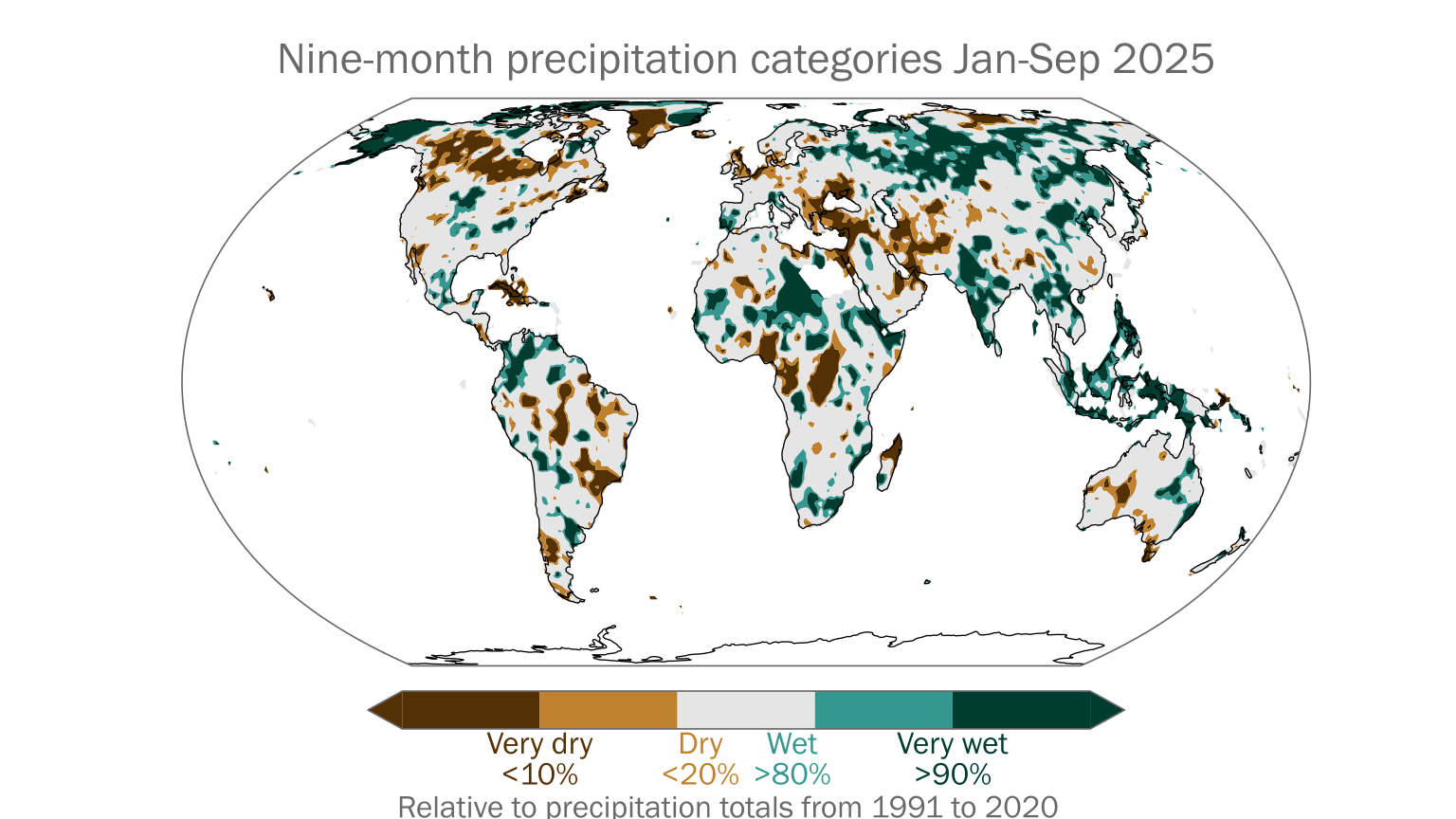
Precipitation
Precipitation quantiles are based on the twelve months aggregated GPCC Monitoring Product and First Guess Monthly product. The baseline period is 1991-2020, using Full Data Monthly in its latest version. Quality controlled rain gauge (in situ) data are used and the quality control protocol depends on the data set. The percentiles are not calculated for those grid cells, where the precipitation total aggregated in the reference period is below ten millimetres.
The data in the above plot are available in a zip file containing a csv file for each data set.
Data file: Precipitation_data_files.zip
Checksum: 76cdb2bad9582d23c1f6f4d868218d6c
Format: BADC CSV format
GPCC
Original data file (external link)
To produce the plot, the following processing steps were performed:
- Gridded dataset created from file ['gpcc_quantile_12month_*-YYYYMMMM.nc.gz'] downloaded from ['https://opendata.dwd.de/climate_environment/GPCC/GPCC_Quantile/Last12Month/gpcc_quantile_12month_*-YYYYMMMM.nc.gz']
- Selected single month 12/2025
Short-term Climate Drivers
The data in the above plot are available in a zip file containing a csv file for each data set.
Data file: Short-term_Climate_Drivers_data_files.zip
Checksum: 1a2ec72baccf79c9768923e2b5c3b4a2
Format: BADC CSV format
ERSSTv5
Original data file (external link)
To produce the plot, the following processing steps were performed:
- Data set created from file ['nina34.data'] downloaded from ['https://psl.noaa.gov/data/correlation/nina34.data'] at ['2026-01-22 15:53:31']
- Rebaselined to 1991-2020 for each month separately by calculating the arithmetic mean of the data over the baseline period and subtracting the mean from all data values. This is done for each month separately (Januarys, Februarys etc).
- Selected years within the range 1950 to 2025.
Page created on 2026-03-17 using climind v1.3.0