Ocean Indicators
Ocean heat content to 2000m
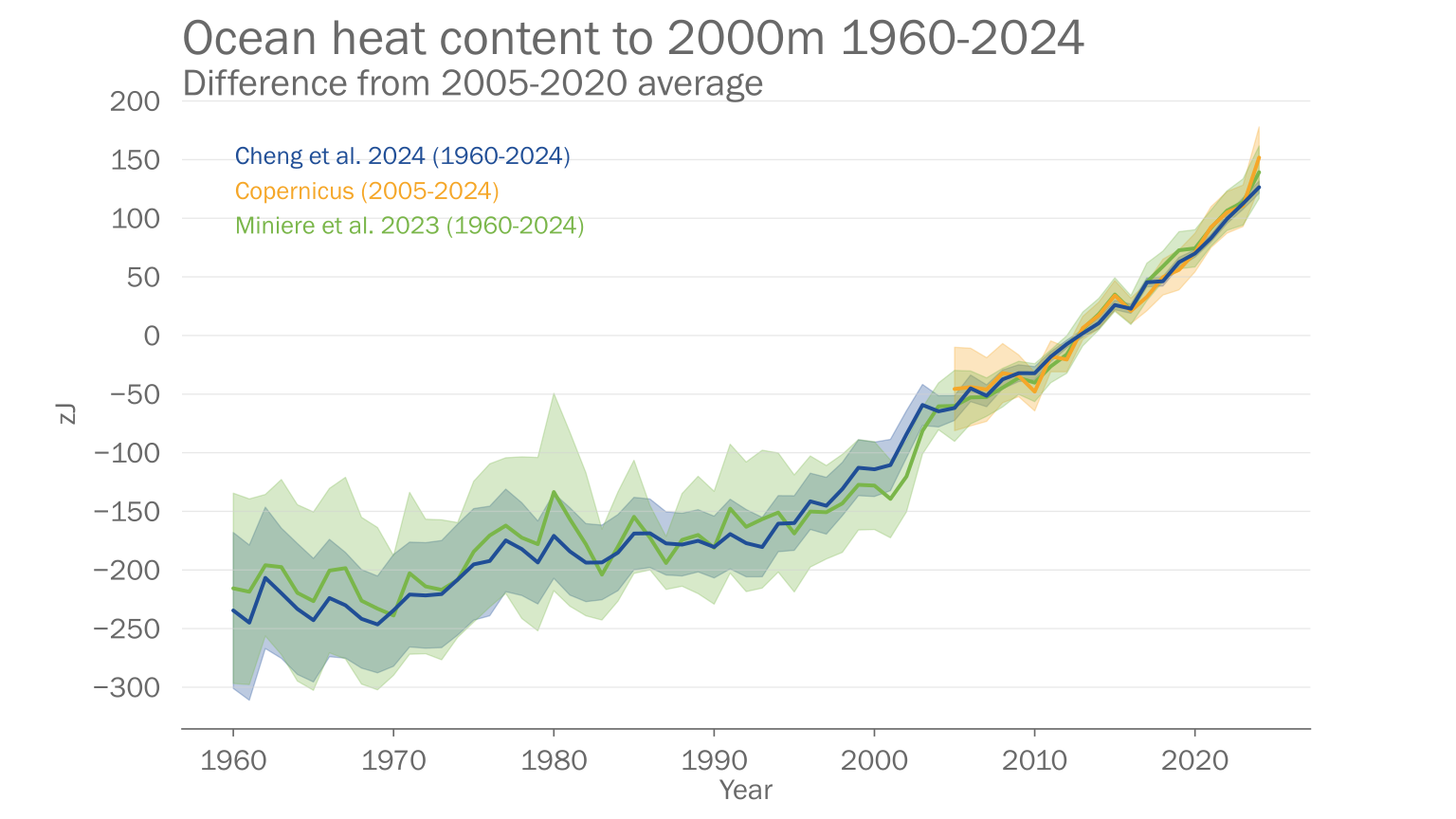
Annual Global ocean heat content (ZJ, difference from the 2005-2025 average) from 1960-2025. Data are from the following four data sets: Cheng et al, Copernicus, von Schuckmann et al., Miniere et al. 2023.
Introduction
The ocean covers nearly 70% of the Earth's surface. Most of the excess energy that accumulates in the Earth system due to increasing concentrations of greenhouse gases is taken up by the ocean. The added energy warms the ocean and this warming causes the water to expand, which in turn leads to sea-level rise. The melting of ice on the land also adds to sea level rise. The surface layers of the ocean have warmed more rapidly than the deeper interior, mirrored in the rise of global mean sea-surface temperature and in the increased incidence of marine heatwaves.
As the concentration of CO2 in the atmosphere increases, so too does the concentration of CO2 in the ocean. This affects ocean chemistry, lowering the average pH of the water, a process known as ocean acidification, though it should be noted that the ocean remains, on average, slightly alkaline. All these changes have a broad range of impacts and interactions in the ocean and coastal areas.
What the IPCC says
A1.6 It is virtually certain that the global upper ocean (0-700 m) has warmed since the 1970s and extremely likely that human influence is the main driver. It is virtually certain that human-caused CO2 emissions are the main driver of current global acidification of the surface open ocean. There is high confidence that oxygen levels have dropped in many upper ocean regions since the mid-20th century and medium confidence that human influence contributed to this drop.
A1.7 Global mean sea level increased by 0.20 [0.15 to 0.25] m between 1901 and 2018. The average rate of sea level rise was 1.3 [0.6 to 2.1] mm.yr-1 between 1901 and 1971, increasing to 1.9 [0.8 to 2.9] mm.yr-1 between 1971 and 2006, and further increasing to 3.7 [3.2 to 4.2] mm.yr-1 between 2006 and 2018 (high confidence). Human influence was very likely the main driver of these increases since at least 1971.
Chapter 2 Ocean pH has declined globally at the surface over the past four decades (virtually certain) and in all ocean basins in the ocean interior (high confidence) over the past 2-3 decades. A long-term increase in surface open ocean pH occurred over the past 50 million years (high confidence), and surface ocean pH as low as recent times is uncommon in the last 2 million years (medium confidence)
Chapter 9 Since the 1980s [marine heatwaves] have also become more intense and longer. Satellite observations and reanalyses of SST show an increase in intensity of 0.04°C per decade from 1982 to 2016, an increase in spatial extent of 19% per decade from 1982 to 2016, and an increase in annual MHW days of 54% between the 1987-2016 period compared to 1925-1954. The SROCC assessed that 84-90% of all MHWs that occurred between 2006 and 2015 are very likely caused by anthropogenic warming. There is new evidence since SROCC that the frequency of the most impactful marine heatwaves over the last few decades has increased more than 20-fold because of anthropogenic global warming. In summary, there is high confidence that MHWs have increased in frequency over the 20th century, with an approximate doubling from 1982 to 2016, and medium confidence that they have become more intense and longer since the 1980s
Key messages
Global ocean heat content 0-2000m
The year 2025 was ranked the 1st highest on record. The mean value for 2025 was 153.73ZJ relative to the 1961-1990 average (139.82-188.92ZJ depending on the data set used). 4 data sets were used in this assessment: Cheng et al, Copernicus, von Schuckmann et al., and Miniere et al. 2023.
The year 2024 was ranked the 2nd highest on record. The mean value for 2024 was 128.98ZJ relative to the 1961-1990 average (112.66-166.04ZJ depending on the data set used). 4 data sets were used in this assessment: Cheng et al, Copernicus, von Schuckmann et al., and Miniere et al. 2023.
Paragraph updated: 2026-03-17 14:19
Global ocean area affected by marine heatwaves
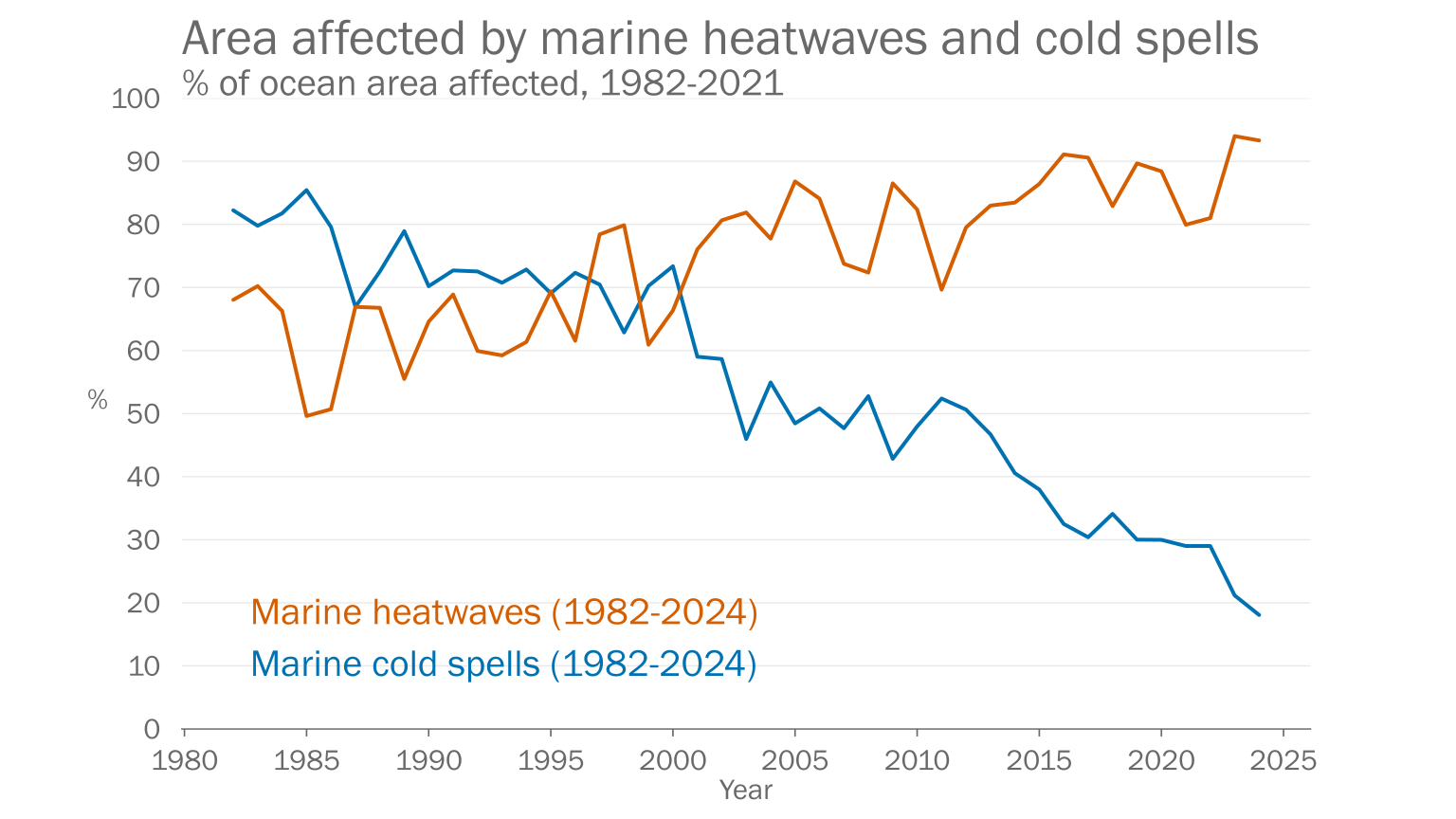
In 2025, 90.1% of the ocean was affected by at least one marine heatwave. The 5th highest on record. The highest ocean area affected in any year was 94.0% in 2023.
Paragraph updated: 2026-03-17 14:19
Global ocean area affected by marine cold spells
The area of the ocean affected by at least one marine cold spells was 18.1%. The 43rd highest on record. The highest area affected in any year by marine cold spells was 85.4% in 1985.
Paragraph updated: 2026-03-17 14:19
Dataset and processing details
Ocean heat content to 2000m
The data in the above plot are available in a zip file containing a csv file for each data set.
Data file: Ocean_heat_content_to_2000m_data_files.zip
Checksum: 0092e56fcd425016b0d58e8124af8f92
Format: BADC CSV format
Cheng et al
Original data file (external link)
Citation:
To produce the plot, the following processing steps were performed:
- Data set created from file ['IAPv4.2_OHC_estimate_update.txt'] downloaded from ['http://www.ocean.iap.ac.cn/ftp/images_files/IAPv4.2_OHC_estimate_update.txt'] at ['2026-01-14 13:47:43']
- Calculated annual average from monthly averages using arithmetic mean
- Rebaselined to 2005-2025 by subtracting the arithemtic mean for that period from all data values.
- Selected years within the range 1960 to 2025.
Copernicus
Original data file (external link)
To produce the plot, the following processing steps were performed:
- Data set created from file ['OHC_area_averaged_anomalies_wmo_glo_19602025_lat60-60_0-2000_R20052024_yearly_jm2_P20260203_new.nc'] downloaded from [''] at ['2026-02-03 17:39:04']
- Rebaselined to 2005-2025 by subtracting the arithemtic mean for that period from all data values.
- Selected years within the range 1960 to 2025.
von Schuckmann et al.
Original data file (external link)
Citations:
- von Schuckmann, K. et al. (2020) Heat stored in the Earth system: where does the energy go?, Earth Syst. Sci. Data, 12, 2013–2041, https://doi.org/10.5194/essd-12-2013-2020, 2020..
- Ishii, M., Y. Fukuda, S. Hirahara, S. Yasui, T. Suzuki, and K. Sato. (2017). Accuracy of Global Upper Ocean Heat Content Estimation Expected from Present Observational Data Sets. SOLA 13 (0): 163–67. https://doi.org/10.2151/sola.2017-030..
- Lyman, J.M., and G.C. Johnson. (2014). Estimating Global Ocean Heat Content Changes in the Upper 1800 m since 1950 and the Influence of Climatology Choice. Journal of Climate 27 (5): 1945–57. https://doi.org/10.1175/JCLI-D-12-00752.1..
- Desbruyères, D., E.L. McDonagh, B.A. King, and V. Thierry. (2017). Global and Full-Depth Ocean Temperature Trends during the Early Twenty-First Century from Argo and Repeat Hydrography. Journal of Climate 30 (6): 1985–97. https://doi.org/10.1175/JCLI-D-16-0396.1..
- Cheng, Lijing, Kevin E. Trenberth, John Fasullo, Tim Boyer, John Abraham, and Jiang Zhu. (2017). Improved Estimates of Ocean Heat Content from 1960 to 2015. Science Advances 3 (3): e1601545. https://doi.org/10.1126/sciadv.1601545..
- Roemmich, D., and J. Gilson. 2009. The 2004–2008 Mean and Annual Cycle of Temperature, Salinity, and Steric Height in the Global Ocean from the Argo Program. Progress in Oceanography 82 (2): 81–100. https://doi.org/10.1016/j.pocean.2009.03.004..
- Good, S.A., M.J. Martin, and N.A. Rayner. (2013). EN4: Quality Controlled Ocean Temperature and Salinity Profiles and Monthly Objective Analyses with Uncertainty Estimates. Journal of Geophysical Research: Oceans 118 (12): 6704–16. https://doi.org/10.1002/2013JC009067..
- Cabanes, C., A. Grouazel, K. Von Schuckmann, et al. (2013). The CORA Dataset: Validation and Diagnostics of in-Situ Ocean Temperature and Salinity Measurements. Ocean Science 9 (1): 1–18. https://doi.org/10.5194/os-9-1-2013..
- Von Schuckmann, K., and P.-Y. Le Traon. (2011). How Well Can We Derive Global Ocean Indicators from Argo Data? Ocean Science 7 (6): 783–91. https://doi.org/10.5194/os-7-783-2011..
- Giglio, D., T. Sukianto, M. Kuusela, and B.K.-A. Mills. (2026). Global Ocean Heat Content Anomalies and Ocean Heat Uptake Based on Mapping Argo Data Using Local Gaussian Processes. Version 4.0.1. Zenodo, February 1. https://doi.org/10.5281/ZENODO.18187866..
- Hosoda, S. (2007). Grid Point Value of the Monthly Objective Analysis Using the Argo Data. JAMSTEC. https://doi.org/10.17596/0000102..
- Hosoda, S., T. Ohira, and T. Nakamura. (2008). A Monthly Mean Dataset of Global Oceanic Temperature and Salinity Derived from Argo Float Observations. JAMSTEC Report of Research and Development 8 (0): 47–59. https://doi.org/10.5918/jamstecr.8.47..
- Li, H., F. Xu, W. Zhou, et al. (2017). Development of a Global Gridded Argo Data Set with Barnes Successive Corrections: A NEW GLOBAL GRIDDED ARGO DATA SET. Journal of Geophysical Research: Oceans 122 (2): 866–89. https://doi.org/10.1002/2016JC012285..
- Domingues, C.M., J.A. Church, N.J. White, et al. (2008). Improved Estimates of Upper-Ocean Warming and Multi-Decadal Sea-Level Rise. Nature 453 (7198): 1090–93. https://doi.org/10.1038/nature07080..
- Church, J.A., N. J. White, L.F. Konikow, et al. (2011). Revisiting the Earths Sea-Level and Energy Budgets from 1961 to 2008: SEA-LEVEL AND ENERGY BUDGETS. Geophysical Research Letters 38 (18): https://doi.org/10.1029/2011GL048794..
- Levitus, S., J. I. Antonov, T. P. Boyer, et al. (2012). World Ocean Heat Content and Thermosteric Sea Level Change (0–2000 m), 1955–2010. Geophysical Research Letters 39 (10): 2012GL051106. https://doi.org/10.1029/2012GL051106..
- Johnson, G.C., and S.G. Purkey. (2024). Refined Estimates of Global Ocean Deep and Abyssal Decadal Warming Trends. Geophysical Research Letters 51 (18): e2024GL111229. https://doi.org/10.1029/2024GL111229..
Notes: The GCOS dataset is an ensemble dataset comprising several individual datasets.
To produce the plot, the following processing steps were performed:
- Data set created from file ['OHC_area_averaged_anomalies_wmo_glo_19602025_lat60-60_0-2000_R20052024_yearly_jm2_P20260203_new.nc'] downloaded from [''] at ['2026-02-03 17:39:19']
- Rebaselined to 2005-2025 by subtracting the arithemtic mean for that period from all data values.
- Selected years within the range 1960 to 2025.
Miniere et al. 2023
Original data file (external link)
Citations:
- Minière, A., von Schuckmann, K., Sallée, JB. et al. Robust acceleration of Earth system heating observed over the past six decades. Sci Rep 13, 22975 (2023). https://doi.org/10.1038/s41598-023-49353-1.
- Ishii, M., Y. Fukuda, S. Hirahara, S. Yasui, T. Suzuki, and K. Sato. (2017). Accuracy of Global Upper Ocean Heat Content Estimation Expected from Present Observational Data Sets. SOLA 13 (0): 163–67. https://doi.org/10.2151/sola.2017-030.
- Lyman, J. M., & Johnson, G. C. (2023). Global High-Resolution Random Forest Regression Maps of Ocean Heat Content Anomalies Using In Situ and Satellite Data. Journal of Atmospheric and Oceanic Technology, 40(5), 575‑586. https://doi.org/10.1175/JTECH-D-22-0058.1.
- Cheng, Lijing, Kevin E. Trenberth, John Fasullo, Tim Boyer, John Abraham, and Jiang Zhu. (2017). Improved Estimates of Ocean Heat Content from 1960 to 2015. Science Advances 3 (3): e1601545. https://doi.org/10.1126/sciadv.1601545..
- Good, S.A., M.J. Martin, and N.A. Rayner. (2013). EN4: Quality Controlled Ocean Temperature and Salinity Profiles and Monthly Objective Analyses with Uncertainty Estimates. Journal of Geophysical Research: Oceans 118 (12): 6704–16. https://doi.org/10.1002/2013JC009067..
- Cheng, L., J. Zhu, R. Cowley, T. Boyer, and S. Wijffels. (2014). Time, Probe Type, and Temperature Variable Bias Corrections to Historical Expendable Bathythermograph Observations. Journal of Atmospheric and Oceanic Technology 31 (8): 1793–825. https://doi.org/10.1175/JTECH-D-13-00197.1..
- Gouretski, V., and F. Reseghetti. (2010). On Depth and Temperature Biases in Bathythermograph Data: Development of a New Correction Scheme Based on Analysis of a Global Ocean Database. Deep Sea Research Part I: Oceanographic Research Papers 57 (6): 812–33. https://doi.org/10.1016/j.dsr.2010.03.011..
- Levitus, S., J. I. Antonov, T. P. Boyer, R. A. Locarnini, H. E. Garcia, and A. V. Mishonov. (2009). Global Ocean Heat Content 1955–2008 in Light of Recently Revealed Instrumentation Problems. Geophysical Research Letters 36 (7): 2008GL037155. https://doi.org/10.1029/2008GL037155..
- Cowley, R., S. Wijffels, L. Cheng, T. Boyer, and S. Kizu. (2013). Biases in Expendable Bathythermograph Data: A New View Based on Historical Side-by-Side Comparisons. Journal of Atmospheric and Oceanic Technology 30 (6): 1195–225. https://doi.org/10.1175/JTECH-D-12-00127.1..
- Cabanes, C., A. Grouazel, K. Von Schuckmann, et al. (2013). The CORA Dataset: Validation and Diagnostics of in-Situ Ocean Temperature and Salinity Measurements. Ocean Science 9 (1): 1–18. https://doi.org/10.5194/os-9-1-2013..
- Szekely, T., Gourrion, J., Pouliquen, S., & Reverdin, G. (2025). CORA, Coriolis Ocean Dataset for Reanalysis. SEANOE. https://doi.org/10.17882/46219.
- Von Schuckmann, K., and P.-Y. Le Traon. (2011). How Well Can We Derive Global Ocean Indicators from Argo Data? Ocean Science 7 (6): 783–91. https://doi.org/10.5194/os-7-783-2011..
- Hosoda, S. (2007). Grid Point Value of the Monthly Objective Analysis Using the Argo Data. JAMSTEC. https://doi.org/10.17596/0000102..
- Hosoda, S., T. Ohira, and T. Nakamura. (2008). A Monthly Mean Dataset of Global Oceanic Temperature and Salinity Derived from Argo Float Observations. JAMSTEC Report of Research and Development 8 (0): 47–59. https://doi.org/10.5918/jamstecr.8.47..
- Li, H., F. Xu, W. Zhou, et al. (2017). Development of a Global Gridded Argo Data Set with Barnes Successive Corrections: A NEW GLOBAL GRIDDED ARGO DATA SET. Journal of Geophysical Research: Oceans 122 (2): 866–89. https://doi.org/10.1002/2016JC012285..
- Buongiorno Nardelli, Bruno. (2020). A Multi-Year Time Series of Observation-Based 3D Horizontal and Vertical Quasi-Geostrophic Global Ocean Currents. Earth System Science Data 12 (3): 1711–23. https://doi.org/10.5194/essd-12-1711-2020..
- Roemmich, D., and J. Gilson. 2009. The 2004–2008 Mean and Annual Cycle of Temperature, Salinity, and Steric Height in the Global Ocean from the Argo Program. Progress in Oceanography 82 (2): 81–100. https://doi.org/10.1016/j.pocean.2009.03.004.
- Levitus, S., J. I. Antonov, T. P. Boyer, et al. (2012). World Ocean Heat Content and Thermosteric Sea Level Change (0–2000 m), 1955–2010. Geophysical Research Letters 39 (10): 2012GL051106. https://doi.org/10.1029/2012GL051106..
- Zhang, C., D. Wang, Z. Liu, et al. (2022). Global Gridded Argo Dataset Based on Gradient-Dependent Optimal Interpolation. Journal of Marine Science and Engineering 10 (5): 650. https://doi.org/10.3390/jmse10050650..
Notes: The Miniere et al. dataset is an ensemble dataset comprising several individual datasets.
To produce the plot, the following processing steps were performed:
- Data set created from file ['OHC_area_averaged_anomalies_wmo_glo_19602025_lat60-60_0-2000_R20052024_yearly_jm2_P20260203_new.nc'] downloaded from [''] at ['2026-02-03 17:39:31']
- Rebaselined to 2005-2025 by subtracting the arithemtic mean for that period from all data values.
- Selected years within the range 1960 to 2025.
Ocean surface pH
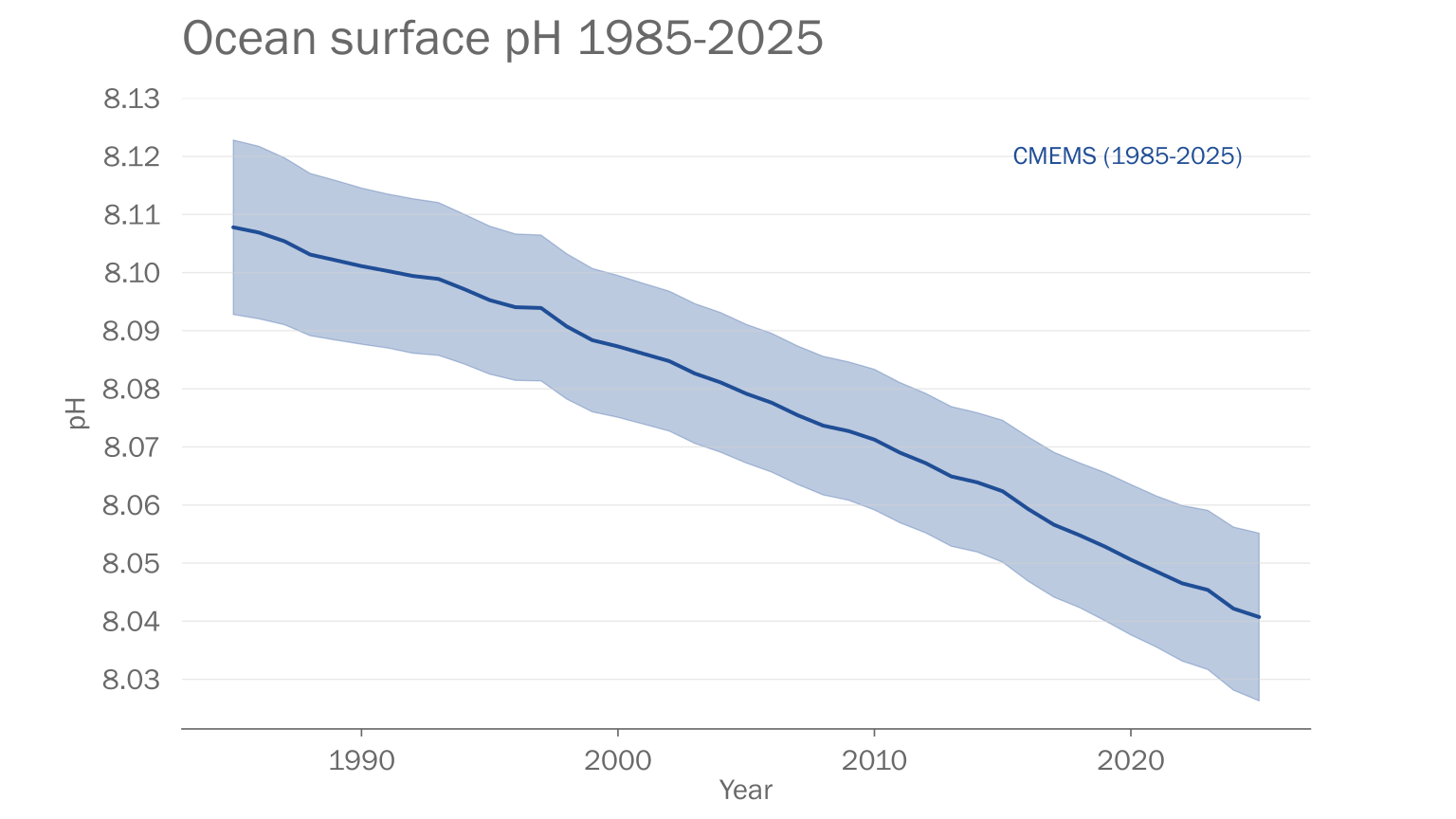
Ocean pH is a measure of how acid/alkaline the ocean surface water is. The ocean surface is typically slightly alkaline, however, increasing concentration of CO2 in the water is driving a decline in pH known as ocean acidification.
The data in the above plot are available in a zip file containing a csv file for each data set.
Data file: Ocean_surface_pH_data_files.zip
Checksum: f4d22b8d927b0a3430ab3490aded59c2
Format: BADC CSV format
CMEMS
Original data file (external link)
Citation:
Data citation: https://doi.org/10.48670/moi-00224
To produce the plot, the following processing steps were performed:
- Data set created from file ['ph_time_serie_1985_2025_mean_std.txt'] downloaded from [''] at ['2026-01-19 15:44:37']
Sea-surface temperature
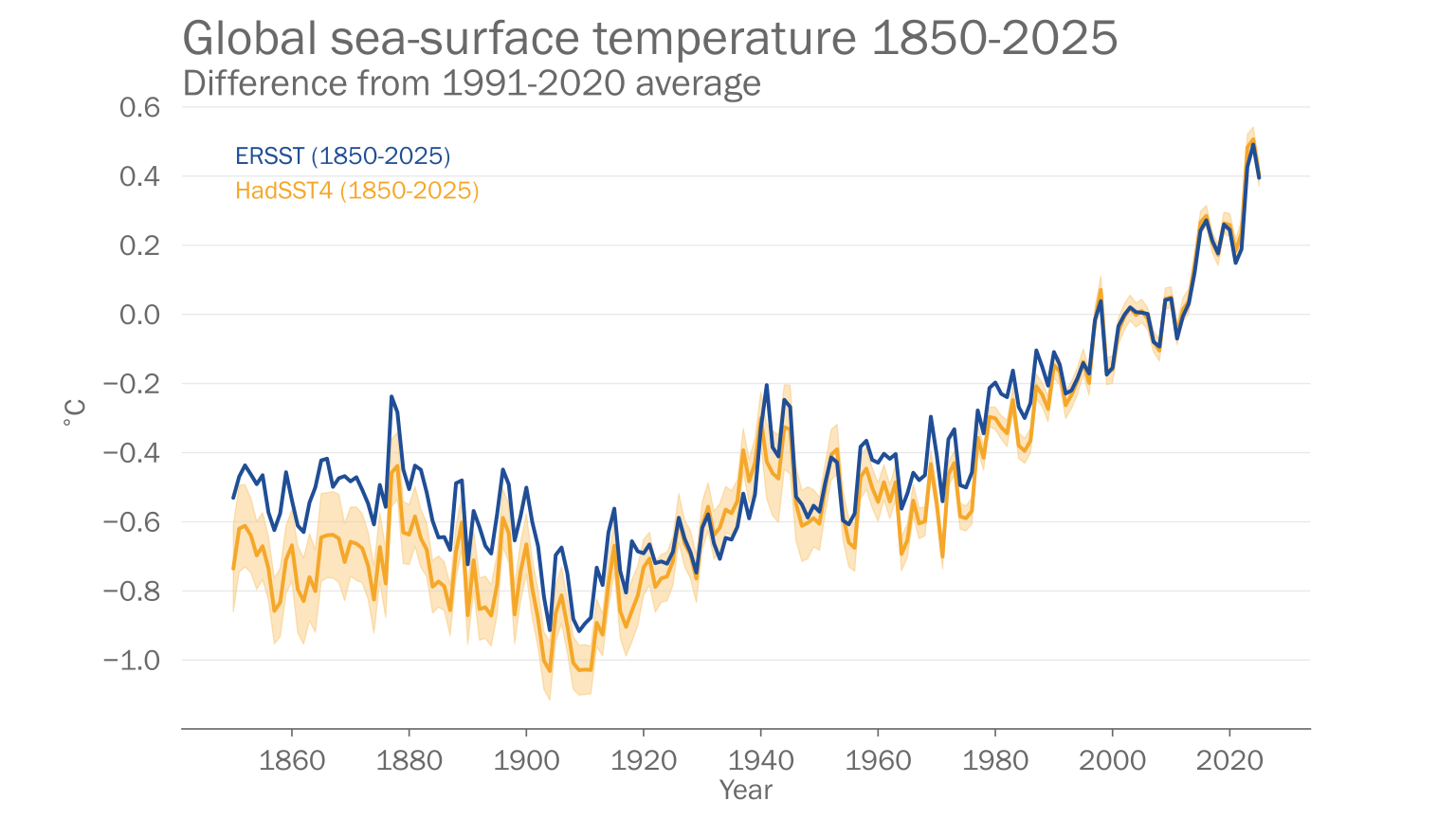
Sea-surface temperature (SST) is the temperature of the surface ocean, typically measured in the upper metre, or metres of the ocean, by ships, buoys and satellites.
The data in the above plot are available in a zip file containing a csv file for each data set.
Data file: Sea-surface_temperature_data_files.zip
Checksum: 78e9c3c7a98524658b98b4ab6a53c374
Format: BADC CSV format
CMA-SST
Citation:
Data citation: https://data.cma.cn/en/#/Visualization/Visualization-detail?id=16
To produce the plot, the following processing steps were performed:
- Data set created from file ['CMA-SST_Global_Month_Temp_1981_2010.csv'] downloaded from [] at ['2026-01-23 09:12:41']
- Calculated annual average from monthly averages using arithmetic mean
- Rebaselined to 1991-2020 by subtracting the arithemtic mean for that period from all data values.
- Selected years within the range 1850 to 2025.
CMEMS
Original data file (external link)
Citations:
- Mulet S., Nardelli B.B., Good S., Pisano A., Greiner E., Monier M., Autret E., Axell L., Boberg F., Ciliberti S. 2018. Ocean temperature and salinity. In: Copernicus marine service ocean state report, issue 2. J Operat Oceanogr. 11(Sup1):s11–ss4. doi:10.1080/1755876X.2018.1489208..
- Good, S.A., Kennedy, J.J, and Embury, O. Global sea surface temperature anomalies in 2018 and historical changes since 1993. In: von Schuckmann et al. 2020, Copernicus Marine Service Ocean State Report, Issue 4, Journal of Operational Oceanography, 13:sup1, S1-S172, doi: 10.1080/1755876X.2020.1785097..
Data citation: https://doi.org/10.48670/moi-00242
To produce the plot, the following processing steps were performed:
- Data set created from file ['global_omi_tempsal_sst_area_averaged_anomalies_19820101-20241231_R19912020_P20250516.nc'] downloaded from ['https://data.marine.copernicus.eu/product/GLOBAL_OMI_TEMPSAL_sst_area_averaged_anomalies/services'] at ['2026-01-27 14:57:52']
- Calculated annual average from monthly averages using arithmetic mean
- Rebaselined to 1991-2020 by subtracting the arithemtic mean for that period from all data values.
- Selected years within the range 1850 to 2025.
DCENT-I
Original data file (external link)
Citations:
- Chan, D., Gebbie, G., Huybers, P. & Kent, E. C. DCENT: Dynamically Consistent ENsemble of Temperature at the Earth Surface. https://doi.org/10.7910/DVN/NU4UGW (2024)..
- Chan, D., Chan, S. C., Siddons, J. T., Cable, A., Cornes, R. C., Kent, E. C., Gebbie, G., & Huybers, P. DCENT-I: A Globally Infilled Extension of the Dynamically Consistent ENsemble of Temperature Dataset. https://doi.org/10.7910/DVN/ZY0WM8 (2025)..
- Chan D., Chan, S. C., Siddons, J. T., Cable, A., Cornes, R. C., Kent, E. C., Gebbie, G., & Huybers, P. (2025). DCENT-I: A Globally Infilled Extension of the Dynamically Consistent ENsemble of Temperature Dataset. Geoscience Data Journal..
To produce the plot, the following processing steps were performed:
- Data set created from file ['DCENT_DCENT_I_OST_annual_statistics_embargo.txt'] downloaded from ['https://dcent-i.github.io/'] at ['2026-01-20 08:43:49']
- Rebaselined to 1991-2020 by subtracting the arithemtic mean for that period from all data values.
- Selected years within the range 1850 to 2025.
ERSST
Original data file (external link) Original data file (external link)
Citation:
Data citation: Boyin Huang, Peter W. Thorne, Viva F. Banzon, Tim Boyer, Gennady Chepurin, Jay H. Lawrimore, Matthew J. Menne, Thomas M. Smith, Russell S. Vose, and Huai-Min Zhang (2017): NOAA Extended Reconstructed Sea Surface Temperature (ERSST), Version 5. [indicate subset used]. NOAA National Centers for Environmental Information. doi:10.7289/V5T72FNM [2026-01-22 15:40:11].
To produce the plot, the following processing steps were performed:
- Data set created from file ['aravg.mon.ocean.90S.90N.v6.0.0.2026MMMM.asc', 'aravg.ann.ocean.90S.90N.v6.0.0.2026MMMM.asc'] downloaded from ['https://www.ncei.noaa.gov/data/noaa-global-surface-temperature/v6/access/timeseries/aravg.mon.ocean.90S.90N.v6.0.0.2026MMMM.asc', 'https://www.ncei.noaa.gov/data/noaa-global-surface-temperature/v6/access/timeseries/aravg.ann.ocean.90S.90N.v6.0.0.2026MMMM.asc'] at ['2026-01-22 15:40:11']
- Calculated annual average from monthly averages using arithmetic mean
- Rebaselined to 1991-2020 by subtracting the arithemtic mean for that period from all data values.
- Selected years within the range 1850 to 2025.
HadSST4
Original data file (external link) Original data file (external link)
Citation:
Acknowledgement: HadSST.4.2.0.0 data were obtained from http://www.metoffice.gov.uk/hadobs/hadsst4 on 2026-01-22 15:40:30 and are © British Crown Copyright, Met Office 2026, provided under an Open Government License, http://www.nationalarchives.gov.uk/doc/open-government-licence/version/3/
To produce the plot, the following processing steps were performed:
- Data set created from file ['HadSST.4.2.0.0_monthly_GLOBE.csv', 'HadSST.4.2.0.0_annual_GLOBE.csv'] downloaded from ['https://www.metoffice.gov.uk/hadobs/hadsst4/data/data/HadSST.4.2.0.0_monthly_GLOBE.csv', 'https://www.metoffice.gov.uk/hadobs/hadsst4/data/data/HadSST.4.2.0.0_annual_GLOBE.csv'] at ['2026-01-22 15:40:30', '2026-01-22 15:40:30']
- Calculated annual average from monthly averages using arithmetic mean
- Rebaselined to 1991-2020 by subtracting the arithemtic mean for that period from all data values.
- Selected years within the range 1850 to 2025.
Marine heat waves
Marine heatwaves (MHWs) are categorized as moderate when the sea-surface temperature (SST) is above the 90th percentile of the climatological distribution for five days or longer; the subsequent categories are defined with respect to the difference between the SST and the climatological distribution average: strong, severe or extreme, if that difference is, respectively, more than two, three or four times the difference between the 90th percentile and the climatological distribution average (Hobday et al., 2018).
Marine cold spells (MCSs) are categorized as moderate when the sea-surface temperature (SST) is below the 10th percentile of the climatological distribution for five days or longer; the subsequent categories are defined with respect to the difference between the SST and the climatological distribution average: strong, severe or extreme, if that difference is, respectively, more than two, three or four times the difference between the 10th percentile and the climatological distribution average (Hobday et al., 2018).
The data in the above plot are available in a zip file containing a csv file for each data set.
Data file: Marine_heat_waves_data_files.zip
Checksum: 2353ed5b2260b6d563a8949c0a1777a5
Format: BADC CSV format
Marine cold spells
Original data file (external link)
Citation:
To produce the plot, the following processing steps were performed:
- Data set created from file ['OISST_MCS_cat_daily_1982-2011_total.csv'] downloaded from ['https://raw.githubusercontent.com/robwschlegel/MHWapp/master/data/annual_summary/OISST_MCS_cat_daily_1982-2011_total.csv'] at ['2026-01-22 15:53:49']
Marine heatwaves
Original data file (external link)
Citation:
To produce the plot, the following processing steps were performed:
- Data set created from file ['OISST_cat_daily_1982-2011_total.csv'] downloaded from ['https://raw.githubusercontent.com/robwschlegel/MHWapp/master/data/annual_summary/OISST_cat_daily_1982-2011_total.csv'] at ['2026-01-22 15:53:49']
Page created on 2026-03-17 using climind v1.3.0