Global mean temperature
Global mean temperature
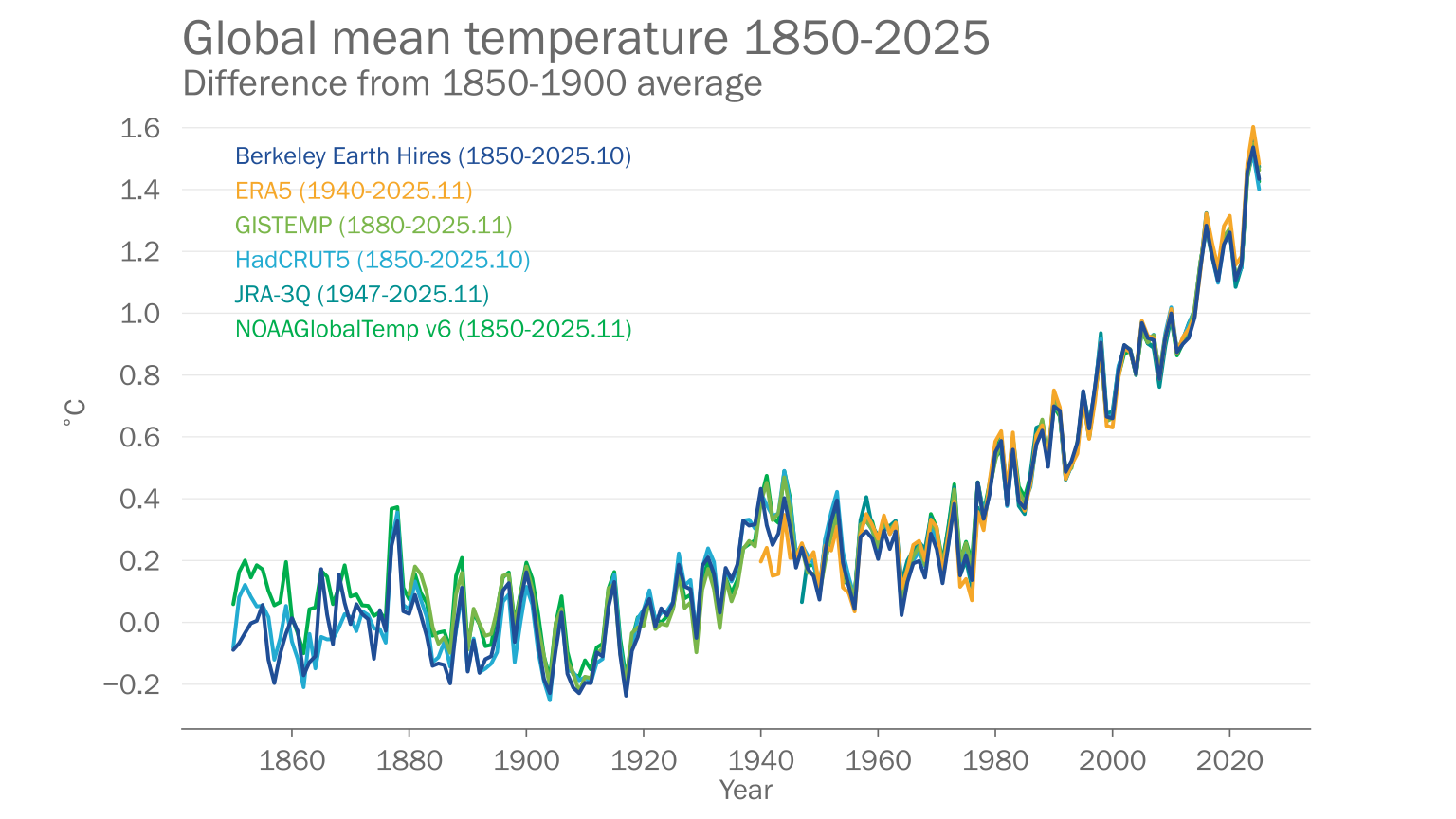
Annual Global mean temperature (°C, difference from the 1850-1900 average) from 1850-2025. Data are from the following nine data sets: Berkeley Earth Hires, CMA-GMST, CMST, DCENT-I, ERA5, GISTEMP, HadCRUT5, JRA-3Q, NOAAGlobalTemp v6.
Temperature anomaly map
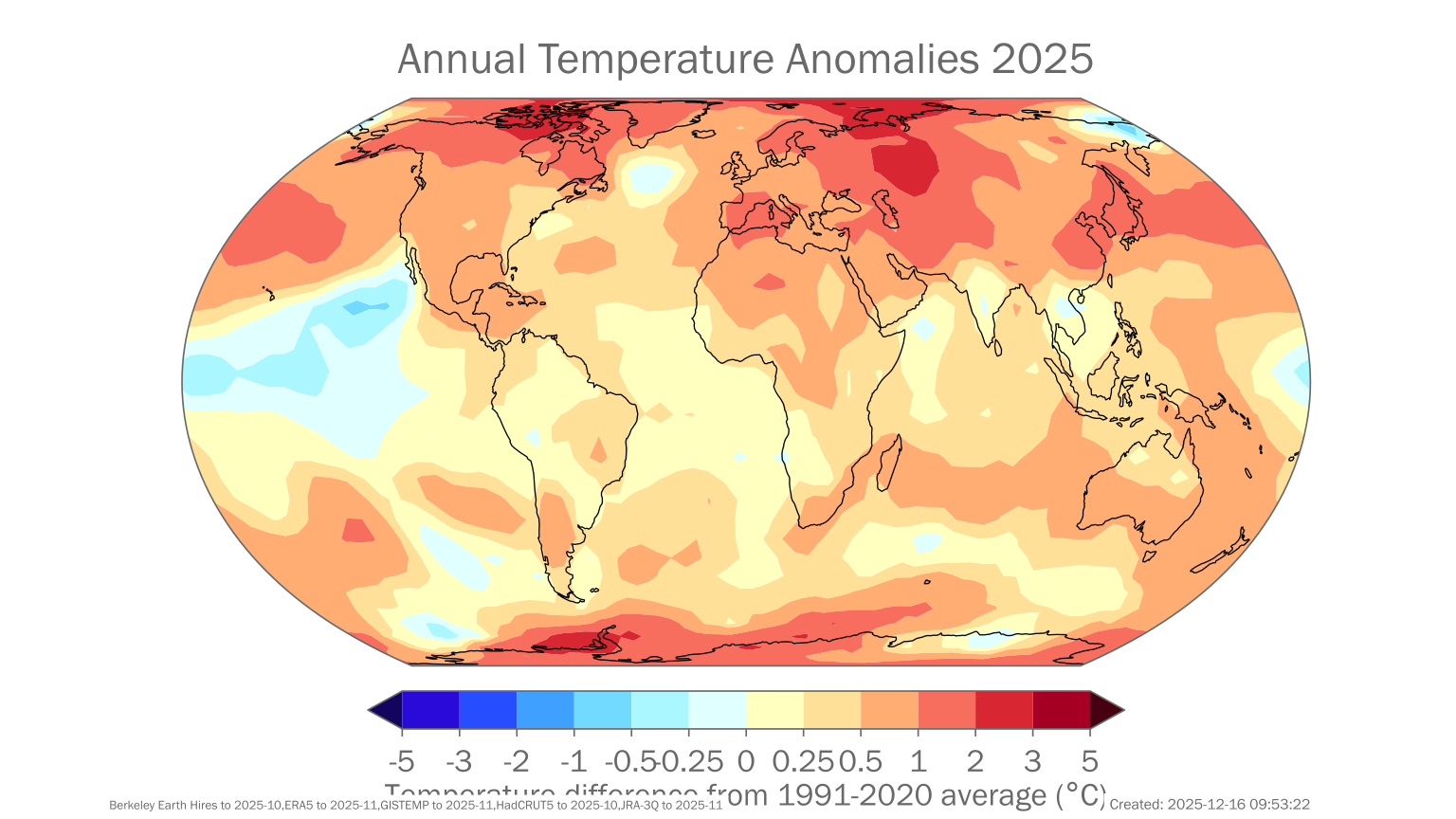
Annual Near surface temperature anomaly (°C, difference from the 1991-2020 average) for 2025. Data shown are the median of the following nine data sets: Berkeley Earth Hires, CMA-GMST, CMST, DCENT-I, ERA5, GISTEMP, HadCRUT5, JRA-3Q, NOAAGlobalTemp v6.
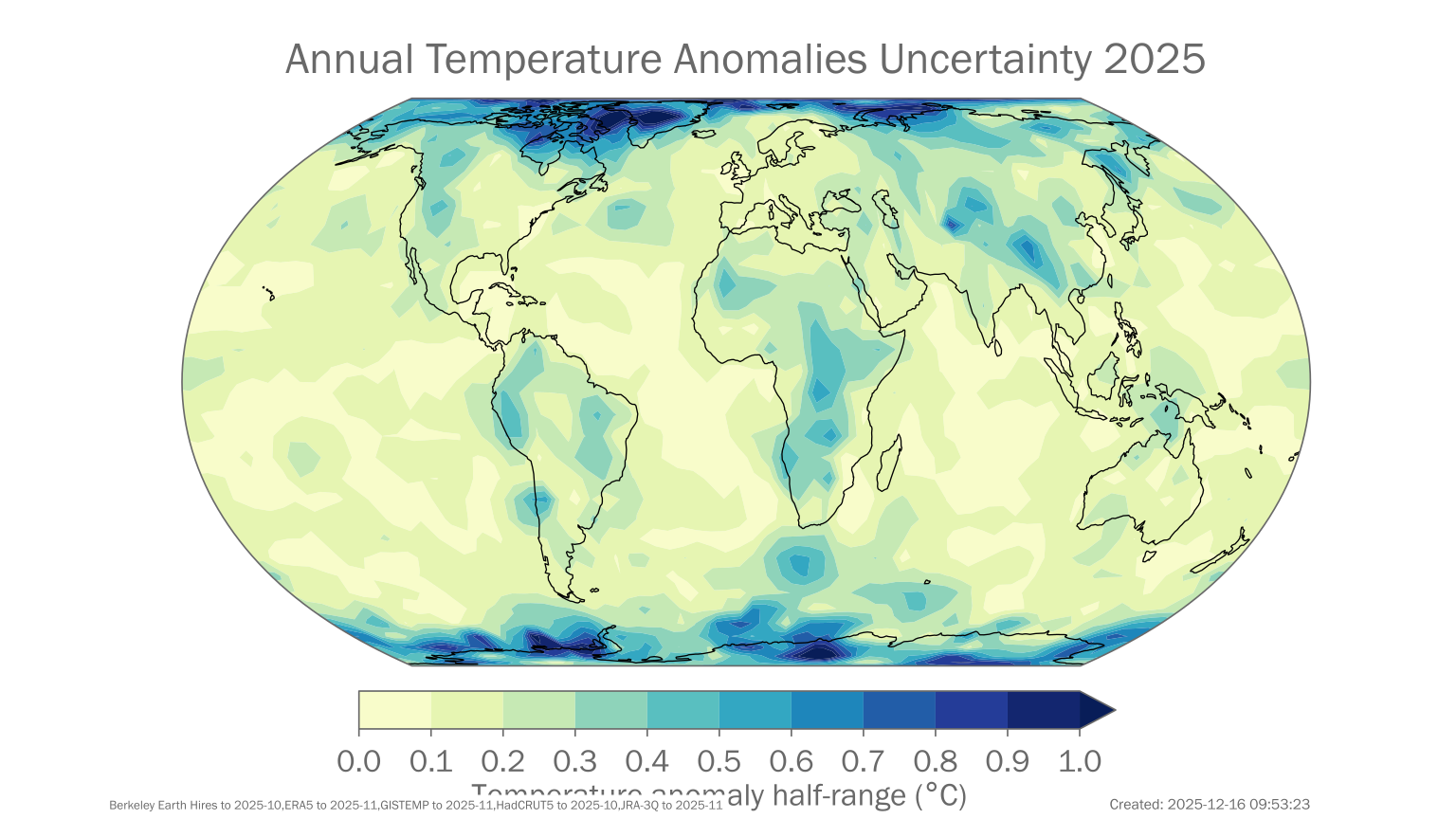
Temperature anomaly uncertainty map
Annual Near surface temperature uncertainty (°C) for 2025. Data shown are the half-range of the following nine data sets: Berkeley Earth Hires, CMA-GMST, CMST, DCENT-I, ERA5, GISTEMP, HadCRUT5, JRA-3Q, NOAAGlobalTemp v6.
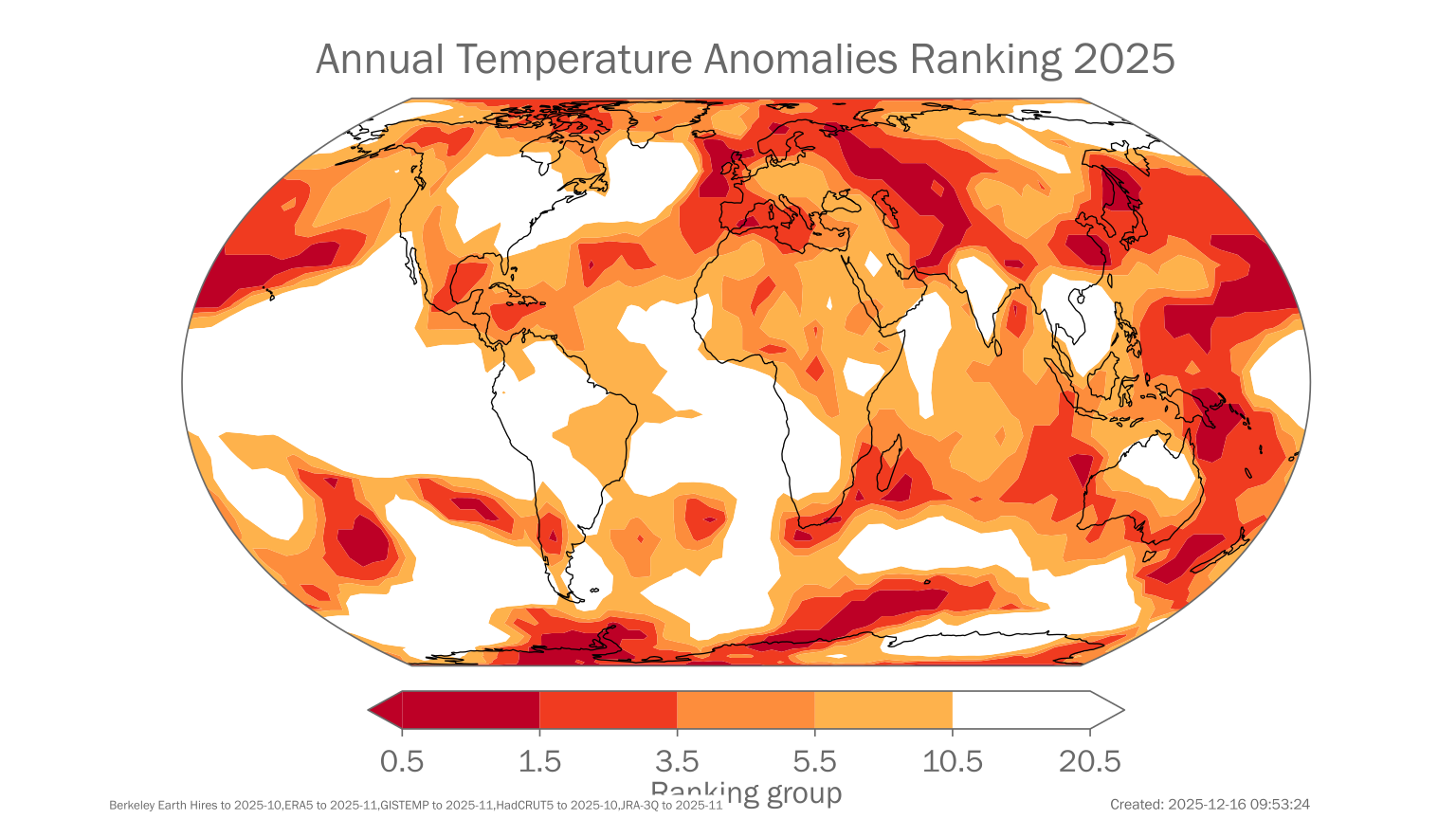
Temperature anomaly rank map
Annual Near surface temperature rank (°C) for 2025. Data shown are the median rank of the following nine data sets: Berkeley Earth Hires, CMA-GMST, CMST, DCENT-I, ERA5, GISTEMP, HadCRUT5, JRA-3Q, NOAAGlobalTemp v6.
Introduction
A key indicator of climate change is the global mean temperature. Global mean temperature measures the change in temperature near the surface of the Earth and averaged across its surface. Increased concentrations of greenhouse gases in the atmosphere are the primary driver of the long-term increase in global mean temperature.
The Paris Agreement aims to hold the increase in the global average temperature to well below 2°C above pre-industrial levels and pursue efforts to limit the temperature increase to 1.5°C above pre-industrial levels, recognizing that this would significantly reduce the risks and impacts of climate change. The Paris Agreement is generally understood to refer to long-term changes in temperature, so a single year that exceeds 1.5°C would not necessarily signal a breach of the threshold.
Warming of the Earth is not the same everywhere. The land has warmed more rapidly than the ocean and the rate of warming has been highest in the Arctic, which has warmed around two to four times faster than the global mean depending on the time period chosen.
What the IPCC says
A.1.2 Each of the last four decades has been successively warmer than any decade that preceded it since 1850. Global surface temperature in the first two decades of the 21st century (2001-2020) was 0.99 [0.84 to 1.10] °C higher than 1850-1900. Global surface temperature was 1.09 [0.95 to 1.20] °C higher in 2011-2020 than 1850-1900, with larger increases over land (1.59 [1.34 to 1.83] °C) than over the ocean (0.88 [0.68 to 1.01] °C). The estimated increase in global surface temperature since AR5 is principally due to further warming since 2003-2012 (+0.19 [0.16 to 0.22] °C). Additionally, methodological advances and new datasets contributed approximately 0.1°C to the updated estimate of warming in AR6.
A.1.3 The likely range of total human-caused global surface temperature increase from 1850-1900 to 2010-2019 is 0.8°C to 1.3°C, with a best estimate of 1.07°C. It is likely that well-mixed GHGs contributed a warming of 1.0°C to 2.0°C, other human drivers (principally aerosols) contributed a cooling of 0.0°C to 0.8°C, natural drivers changed global surface temperature by -0.1°C to +0.1°C, and internal variability changed it by -0.2°C to +0.2°C. It is very likely that well-mixed GHGs were the main driver of tropospheric warming since 1979 and extremely likely that human-caused stratospheric ozone depletion was the main driver of cooling of the lower stratosphere between 1979 and the mid-1990s.
Key messages
Global mean temperature
The year 2025 was ranked between the 2nd and 3rd warmest on record. The anomaly for 2025 was 1.43 [1.31 to 1.56]°C relative to the 1850-1900 average 9 data sets were used in this assessment: Berkeley Earth Hires, CMA-GMST, CMST, DCENT-I, ERA5, GISTEMP, HadCRUT5, JRA-3Q, and NOAAGlobalTemp v6.
Paragraph updated: 2026-03-17 14:19
Global mean sea-surface temperature
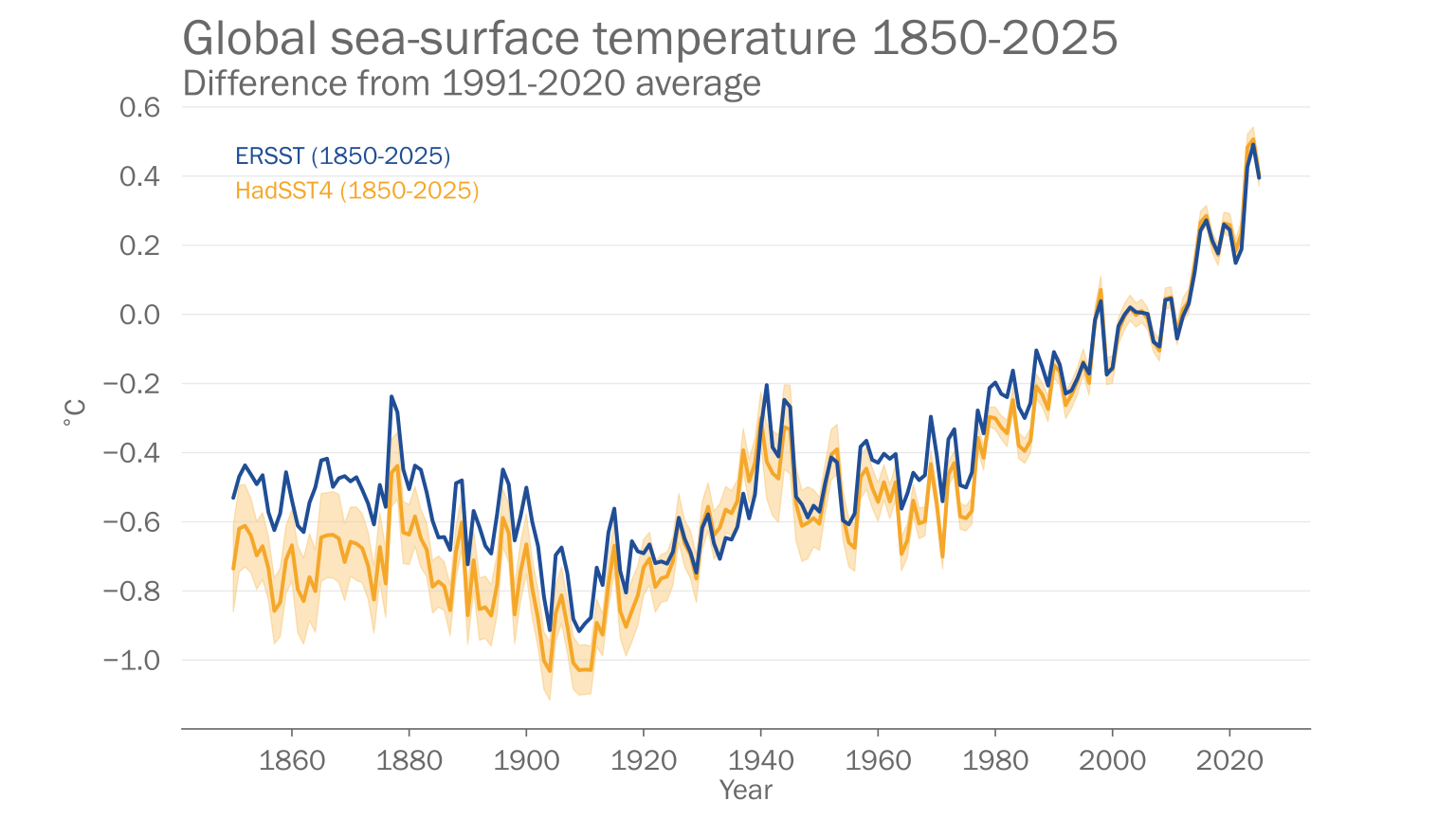
The year 2025 was ranked the 3rd warmest on record. The mean value for 2025 was 0.39°C relative to the 1991-2020 average (0.36-0.40°C depending on the data set used). 4 data sets were used in this assessment: CMA-SST, DCENT-I, ERSST, and HadSST4. 1 data set was not used in the assessment (CMEMS) because its last year is before 2025. The warmest year on record was 2024 with a value between 0.44 and 0.51 °C.
The year 2024 was ranked the 1st warmest on record. The mean value for 2024 was 0.48°C relative to the 1991-2020 average (0.44-0.51°C depending on the data set used). 5 data sets were used in this assessment: CMA-SST, CMEMS, DCENT-I, ERSST, and HadSST4.
Paragraph updated: 2026-03-17 14:19
Global mean land temperature
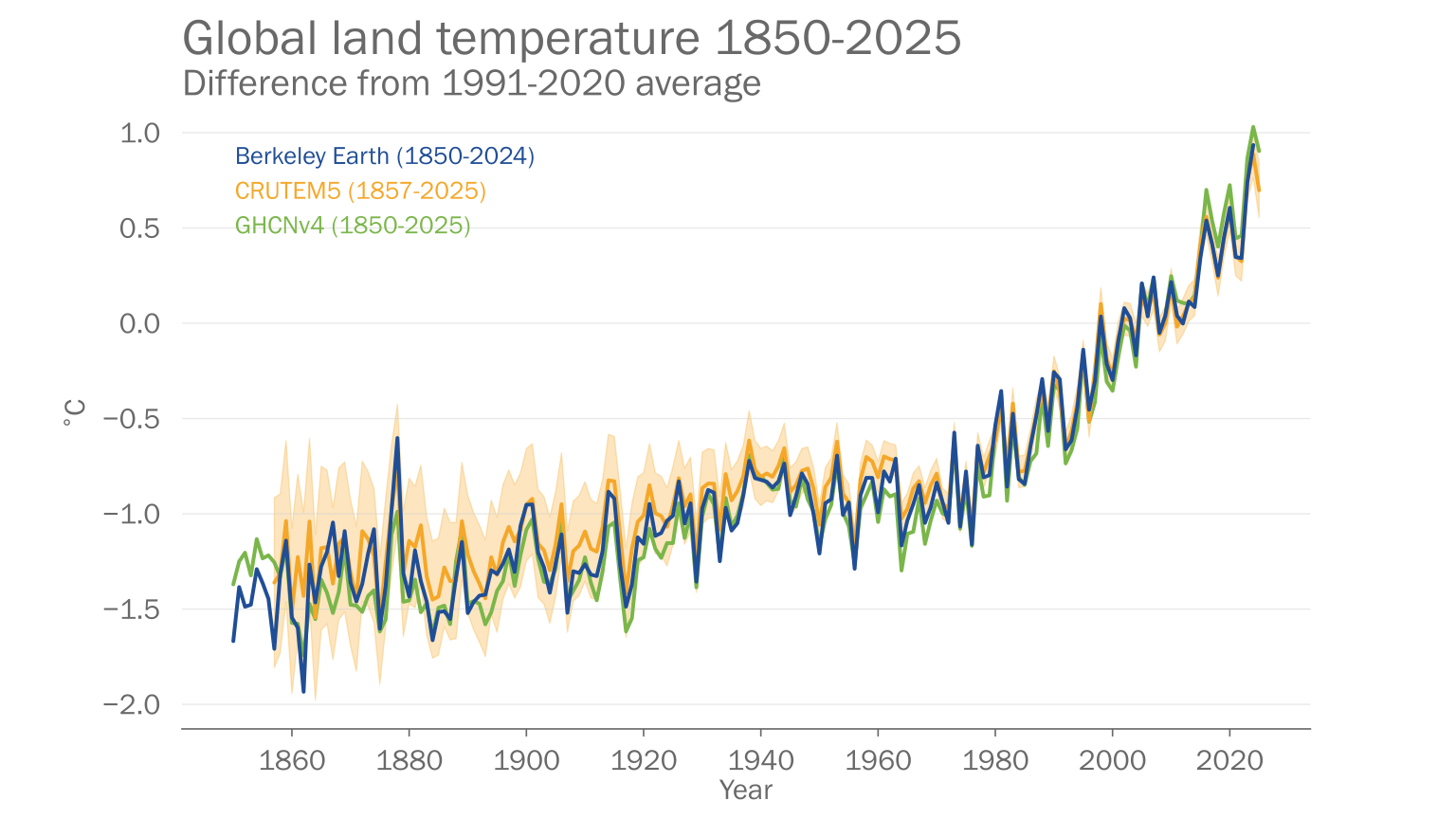
The year 2025 was ranked between the 2nd and 3rd warmest on record. The mean value for 2025 was 0.80°C relative to the 1991-2020 average (0.69-0.88°C depending on the data set used). 6 data sets were used in this assessment: Berkeley Earth Hires (to Nov 2025), CLSAT, CMA-GLST, CRUTEM5, DCENT-I, and GHCNv4.The warmest year on record was 2024 with a value between 0.89 and 1.04 °C.
The year 2024 was ranked the 1st warmest on record. The mean value for 2024 was 0.96°C relative to the 1991-2020 average (0.89-1.04°C depending on the data set used). 6 data sets were used in this assessment: Berkeley Earth Hires, CLSAT, CMA-GLST, CRUTEM5, DCENT-I, and GHCNv4.
Paragraph updated: 2026-03-17 14:19
Dataset and processing details
Global mean temperature
Global mean temperature is based on measurements made at weather stations over land and by ships and buoys over the ocean. Temperatures are typically expressed as anomalies which are temperature differences from the average for a standard period. Here, 1850-1900 is used for the global mean. Instrumental temperature records are some of the longest climate records available, with some series extending back to the 17th century.
The data in the above plot are available in a zip file containing a csv file for each data set.
Data file: Global_mean_temperature_data_files.zip
Checksum: 9d002ad87366215af782ee5f1dc29504
Format: BADC CSV format
Berkeley Earth Hires
Original data file (external link)
Citation:
To produce the plot, the following processing steps were performed:
- Data set created from file ['Global_TAVG_monthly.txt'] downloaded from ['https://storage.googleapis.com/berkeley-earth-temperature-hr/global/Global_TAVG_monthly.txt'] at ['2026-01-22 15:38:43']
- Rebaselined to 1981-2010 for each month separately by calculating the arithmetic mean of the data over the baseline period and subtracting the mean from all data values. This is done for each month separately (Januarys, Februarys etc).
- Calculated annual average from monthly averages using arithmetic mean
- Selected years within the range 1850 to 2025.
- Added offset of 0.69 to all data values.
- Manually changed baseline to 1850-1900. Note that data values remain unchanged.
CMA-GMST
Citation:
Data citation: https://data.cma.cn/en/#/Visualization/Visualization-detail?id=16
To produce the plot, the following processing steps were performed:
- Data set created from file ['CMA-GMST_Global_Month_Temp_1981_2010.csv'] downloaded from [] at ['2026-01-15 15:34:35']
- Rebaselined to 1981-2010 for each month separately by calculating the arithmetic mean of the data over the baseline period and subtracting the mean from all data values. This is done for each month separately (Januarys, Februarys etc).
- Calculated annual average from monthly averages using arithmetic mean
- Selected years within the range 1850 to 2025.
- Added offset of 0.69 to all data values.
- Manually changed baseline to 1850-1900. Note that data values remain unchanged.
CMST
Original data file (external link)
Citation:
To produce the plot, the following processing steps were performed:
- Data set created from file ['CMST_monthly.csv'] downloaded from ['http://www.gwpu.net/en/h-nd-166.html'] at ['2026-01-07 15:06:56']
- Rebaselined to 1981-2010 for each month separately by calculating the arithmetic mean of the data over the baseline period and subtracting the mean from all data values. This is done for each month separately (Januarys, Februarys etc).
- Calculated annual average from monthly averages using arithmetic mean
- Selected years within the range 1850 to 2025.
- Added offset of 0.69 to all data values.
- Manually changed baseline to 1850-1900. Note that data values remain unchanged.
DCENT-I
Original data file (external link)
Citations:
- Chan, D., Gebbie, G., Huybers, P. & Kent, E. C. DCENT: Dynamically Consistent ENsemble of Temperature at the Earth Surface. https://doi.org/10.7910/DVN/NU4UGW (2024)..
- Chan, D., Chan, S. C., Siddons, J. T., Cable, A., Cornes, R. C., Kent, E. C., Gebbie, G., & Huybers, P. DCENT-I: A Globally Infilled Extension of the Dynamically Consistent ENsemble of Temperature Dataset. https://doi.org/10.7910/DVN/ZY0WM8 (2025)..
- Chan D., Chan, S. C., Siddons, J. T., Cable, A., Cornes, R. C., Kent, E. C., Gebbie, G., & Huybers, P. (2025). DCENT-I: A Globally Infilled Extension of the Dynamically Consistent ENsemble of Temperature Dataset. Geoscience Data Journal..
To produce the plot, the following processing steps were performed:
- Data set created from file ['DCENT_DCENT_I_GMST_monthly_statistics_embargo.txt'] downloaded from ['https://dcent-i.github.io/'] at ['2026-01-22 15:58:19']
- Rebaselined to 1981-2010 for each month separately by calculating the arithmetic mean of the data over the baseline period and subtracting the mean from all data values. This is done for each month separately (Januarys, Februarys etc).
- Calculated annual average from monthly averages using arithmetic mean
- Selected years within the range 1850 to 2025.
- Added offset of 0.69 to all data values.
- Manually changed baseline to 1850-1900. Note that data values remain unchanged.
ERA5
Original data file (external link)
Citation:
Data citation: Hersbach, H., Bell, B., Berrisford, P., Biavati, G., Horányi, A., Muñoz Sabater, J., Nicolas, J., Peubey, C., Radu, R., Rozum, I., Schepers, D., Simmons, A., Soci, C., Dee, D., Thépaut, J-N. (2023): ERA5 monthly averaged data on single levels from 1940 to present. Copernicus Climate Change Service (C3S) Climate Data Store (CDS), DOI: 10.24381/cds.f17050d7 (Accessed on 2026-01-22 15:38:55)
Acknowledgement: Contains using Copernicus Climate Change Service information [2026]. Neither the European Commission nor ECMWF is responsible for any use that may be made of the Copernicus information or data it contains.
To produce the plot, the following processing steps were performed:
- Data set created from file ['C3S_Bulletin_temp_202512_Fig1b_timeseries_anomalies_ref1991-2020_global_allmonths_DATA.csv'] downloaded from ['https://climate.copernicus.eu/sites/default/files/2026-MMMM/C3S_Bulletin_temp_YLYLMLML_Fig1b_timeseries_anomalies_ref1991-2020_global_allmonths_DATA.csv'] at ['2026-01-22 15:38:55']
- Rebaselined to 1981-2010 for each month separately by calculating the arithmetic mean of the data over the baseline period and subtracting the mean from all data values. This is done for each month separately (Januarys, Februarys etc).
- Calculated annual average from monthly averages using arithmetic mean
- Selected years within the range 1850 to 2025.
- Added offset of 0.69 to all data values.
- Manually changed baseline to 1850-1900. Note that data values remain unchanged.
GISTEMP
Original data file (external link)
Citation:
Data citation: GISTEMP Team, 2022: GISS Surface Temperature Analysis (GISTEMP), version 4. NASA Goddard Institute for Space Studies. Dataset accessed 2026-01-22 15:39:23 at data.giss.nasa.gov/gistemp/.
To produce the plot, the following processing steps were performed:
- Data set created from file ['GLB.Ts+dSST.csv'] downloaded from ['https://data.giss.nasa.gov/gistemp/tabledata_v4/GLB.Ts+dSST.csv'] at ['2026-01-22 15:39:23']
- Rebaselined to 1981-2010 for each month separately by calculating the arithmetic mean of the data over the baseline period and subtracting the mean from all data values. This is done for each month separately (Januarys, Februarys etc).
- Calculated annual average from monthly averages using arithmetic mean
- Selected years within the range 1850 to 2025.
- Added offset of 0.69 to all data values.
- Manually changed baseline to 1850-1900. Note that data values remain unchanged.
HadCRUT5
Original data file (external link) Original data file (external link)
Citation:
Acknowledgement: HadCRUT.5.1.0.0 data were obtained from http://www.metoffice.gov.uk/hadobs/hadcrut5 on 2026-01-22 15:39:05 and are © British Crown Copyright, Met Office 2026, provided under an Open Government License, http://www.nationalarchives.gov.uk/doc/open-government-licence/version/3/
To produce the plot, the following processing steps were performed:
- Data set created from file ['HadCRUT.5.1.0.0.analysis.summary_series.global.monthly.csv', 'HadCRUT.5.1.0.0.analysis.summary_series.global.annual.csv'] downloaded from ['https://www.metoffice.gov.uk/hadobs/hadcrut5/data/HadCRUT.5.0.2.0/analysis/diagnostics/HadCRUT.5.1.0.0.analysis.summary_series.global.monthly.csv', 'https://www.metoffice.gov.uk/hadobs/hadcrut5/data/HadCRUT.5.0.2.0/analysis/diagnostics/HadCRUT.5.1.0.0.analysis.summary_series.global.annual.csv'] at ['2026-01-22 15:39:05', '2026-01-22 15:39:05']
- Rebaselined to 1981-2010 for each month separately by calculating the arithmetic mean of the data over the baseline period and subtracting the mean from all data values. This is done for each month separately (Januarys, Februarys etc).
- Calculated annual average from monthly averages using arithmetic mean
- Selected years within the range 1850 to 2025.
- Added offset of 0.69 to all data values.
- Manually changed baseline to 1850-1900. Note that data values remain unchanged.
JRA-3Q
Original data file (external link)
Citation:
Data citation: Japan Meteorological Agency. 2023, updated monthly. Japanese Reanalysis for Three Quarters of a Century (JRA-3Q). Research Data Archive at the National Center for Atmospheric Research, Computational and Information Systems Laboratory. https://doi.org/10.5065/AVTZ-1H78. Accessed 2026-03-09 16:24:44.
To produce the plot, the following processing steps were performed:
- Data set created from file ['JRA-3Q_tmp2m_global_ts_125_Clim9120.txt'] downloaded from [''] at ['2026-03-09 16:24:44']
- Rebaselined to 1981-2010 for each month separately by calculating the arithmetic mean of the data over the baseline period and subtracting the mean from all data values. This is done for each month separately (Januarys, Februarys etc).
- Calculated annual average from monthly averages using arithmetic mean
- Selected years within the range 1850 to 2025.
- Added offset of 0.69 to all data values.
- Manually changed baseline to 1850-1900. Note that data values remain unchanged.
NOAAGlobalTemp v6
Original data file (external link) Original data file (external link)
Citation:
Data citation: Huang, Boyin; Yin, Xungang; Menne, Matthew J.; Vose, Russell S.; and Zhang, Huai-Min. 2024. NOAA Global Surface Temperature Dataset (NOAAGlobalTemp), Version 6.0.. NOAA National Centers for Environmental Information. https://doi.org/10.25921/rzxg-p717. Accessed 2026-01-22 15:39:10.
To produce the plot, the following processing steps were performed:
- Data set created from file ['aravg.mon.land_ocean.90S.90N.v6.0.0.202512.asc', 'aravg.ann.land_ocean.90S.90N.*.asc'] downloaded from ['https://www.ncei.noaa.gov/data/noaa-global-surface-temperature/v6/access/timeseries/aravg.mon.land_ocean.90S.90N.v6.0.0.202512.asc', 'https://www.ncei.noaa.gov/data/noaa-global-surface-temperature/v6/access/timeseries/aravg.ann.land_ocean.90S.90N.*.asc'] at ['2026-01-22 15:39:10']
- Rebaselined to 1981-2010 for each month separately by calculating the arithmetic mean of the data over the baseline period and subtracting the mean from all data values. This is done for each month separately (Januarys, Februarys etc).
- Calculated annual average from monthly averages using arithmetic mean
- Selected years within the range 1850 to 2025.
- Added offset of 0.69 to all data values.
- Manually changed baseline to 1850-1900. Note that data values remain unchanged.
Land air temperature
Land surface air temperature is the temperature of air approximately 2m above the surface. It is measured at weather stations around the world. The thermometers used are typically housed in screens that shield the thermometer from direct sunlight, while allowing air to circulate freely.
The data in the above plot are available in a zip file containing a csv file for each data set.
Data file: Land_air_temperature_data_files.zip
Checksum: f33ec35aa62f4bffbc75e1f8c0d6bd33
Format: BADC CSV format
Berkeley Earth Hires
Original data file (external link)
Citation:
Notes: The data is an experimental high-resolution update of the Berkeley Earth dataset.
To produce the plot, the following processing steps were performed:
- Data set created from file ['Land_TAVG_monthly.txt'] downloaded from ['https://storage.googleapis.com/berkeley-earth-temperature-hr/global/Land_TAVG_monthly.txt'] at ['2026-01-22 15:39:14']
- Calculated annual average from monthly averages using arithmetic mean
- Rebaselined to 1991-2020 by subtracting the arithemtic mean for that period from all data values.
- Selected years within the range 1850 to 2025.
CLSAT
Original data file (external link)
Citation:
To produce the plot, the following processing steps were performed:
- Data set created from file ['CMST_GLSAT.csv'] downloaded from [''] at ['2026-01-23 09:48:57']
- Calculated annual average from monthly averages using arithmetic mean
- Rebaselined to 1991-2020 by subtracting the arithemtic mean for that period from all data values.
- Selected years within the range 1850 to 2025.
CMA-GLST
Citation:
Data citation: https://data.cma.cn/en/#/Visualization/Visualization-detail?id=16
To produce the plot, the following processing steps were performed:
- Data set created from file ['CMA-GLST_Global_Month_Temp_1981_2010.csv'] downloaded from [] at ['2026-01-23 09:12:25']
- Calculated annual average from monthly averages using arithmetic mean
- Rebaselined to 1991-2020 by subtracting the arithemtic mean for that period from all data values.
- Selected years within the range 1850 to 2025.
CRUTEM5
Original data file (external link) Original data file (external link)
Citation:
Acknowledgement: CRUTEM.5.1.0.0 data were obtained from http://www.metoffice.gov.uk/hadobs/crutem5 on 2026-01-22 15:39:16 and are © British Crown Copyright, Met Office 2026, provided under an Open Government License, http://www.nationalarchives.gov.uk/doc/open-government-licence/version/3/
To produce the plot, the following processing steps were performed:
- Data set created from file ['CRUTEM.5.1.0.0.summary_series.global.monthly.csv', 'CRUTEM.5.1.0.0.summary_series.global.annual.csv'] downloaded from ['https://www.metoffice.gov.uk/hadobs/crutem5/data/CRUTEM.5.1.0.0/diagnostics/CRUTEM.5.1.0.0.summary_series.global.monthly.csv', 'https://www.metoffice.gov.uk/hadobs/crutem5/data/CRUTEM.5.1.0.0/diagnostics/CRUTEM.5.1.0.0.summary_series.global.annual.csv'] at ['2026-01-22 15:39:16', '2026-01-22 15:39:16']
- Rebaselined to 1991-2020 by subtracting the arithemtic mean for that period from all data values.
- Selected years within the range 1850 to 2025.
DCENT-I
Original data file (external link)
Citations:
- Chan, D., Gebbie, G., Huybers, P. & Kent, E. C. DCENT: Dynamically Consistent ENsemble of Temperature at the Earth Surface. https://doi.org/10.7910/DVN/NU4UGW (2024)..
- Chan, D., Chan, S. C., Siddons, J. T., Cable, A., Cornes, R. C., Kent, E. C., Gebbie, G., & Huybers, P. DCENT-I: A Globally Infilled Extension of the Dynamically Consistent ENsemble of Temperature Dataset. https://doi.org/10.7910/DVN/ZY0WM8 (2025)..
- Chan D., Chan, S. C., Siddons, J. T., Cable, A., Cornes, R. C., Kent, E. C., Gebbie, G., & Huybers, P. (2025). DCENT-I: A Globally Infilled Extension of the Dynamically Consistent ENsemble of Temperature Dataset. Geoscience Data Journal..
To produce the plot, the following processing steps were performed:
- Data set created from file ['DCENT_DCENT_I_LST_annual_statistics_embargo.txt'] downloaded from ['https://dcent-i.github.io/'] at ['2026-01-20 08:43:45']
- Rebaselined to 1991-2020 by subtracting the arithemtic mean for that period from all data values.
- Selected years within the range 1850 to 2025.
GHCNv4
Original data file (external link) Original data file (external link)
Citation:
To produce the plot, the following processing steps were performed:
- Data set created from file ['aravg.mon.land.90S.90N.v6.0.0.2026MMMM.asc', 'aravg.ann.land.90S.90N.v6.0.0.2026MMMM.asc'] downloaded from ['https://www.ncei.noaa.gov/data/noaa-global-surface-temperature/v6/access/timeseries/aravg.mon.land.90S.90N.v6.0.0.2026MMMM.asc', 'https://www.ncei.noaa.gov/data/noaa-global-surface-temperature/v6/access/timeseries/aravg.ann.land.90S.90N.v6.0.0.2026MMMM.asc'] at ['2026-01-22 15:39:35']
- Calculated annual average from monthly averages using arithmetic mean
- Rebaselined to 1991-2020 by subtracting the arithemtic mean for that period from all data values.
- Selected years within the range 1850 to 2025.
Sea-surface temperature
Sea-surface temperature (SST) is the temperature of the surface ocean, typically measured in the upper metre, or metres of the ocean, by ships, buoys and satellites.
The data in the above plot are available in a zip file containing a csv file for each data set.
Data file: Sea-surface_temperature_data_files.zip
Checksum: 97edb7e7d156ac4564d2bffd0f6fad74
Format: BADC CSV format
CMA-SST
Citation:
Data citation: https://data.cma.cn/en/#/Visualization/Visualization-detail?id=16
To produce the plot, the following processing steps were performed:
- Data set created from file ['CMA-SST_Global_Month_Temp_1981_2010.csv'] downloaded from [] at ['2026-01-23 09:12:41']
- Calculated annual average from monthly averages using arithmetic mean
- Rebaselined to 1991-2020 by subtracting the arithemtic mean for that period from all data values.
- Selected years within the range 1850 to 2025.
CMEMS
Original data file (external link)
Citations:
- Mulet S., Nardelli B.B., Good S., Pisano A., Greiner E., Monier M., Autret E., Axell L., Boberg F., Ciliberti S. 2018. Ocean temperature and salinity. In: Copernicus marine service ocean state report, issue 2. J Operat Oceanogr. 11(Sup1):s11–ss4. doi:10.1080/1755876X.2018.1489208..
- Good, S.A., Kennedy, J.J, and Embury, O. Global sea surface temperature anomalies in 2018 and historical changes since 1993. In: von Schuckmann et al. 2020, Copernicus Marine Service Ocean State Report, Issue 4, Journal of Operational Oceanography, 13:sup1, S1-S172, doi: 10.1080/1755876X.2020.1785097..
Data citation: https://doi.org/10.48670/moi-00242
To produce the plot, the following processing steps were performed:
- Data set created from file ['global_omi_tempsal_sst_area_averaged_anomalies_19820101-20241231_R19912020_P20250516.nc'] downloaded from ['https://data.marine.copernicus.eu/product/GLOBAL_OMI_TEMPSAL_sst_area_averaged_anomalies/services'] at ['2026-01-27 14:57:52']
- Calculated annual average from monthly averages using arithmetic mean
- Rebaselined to 1991-2020 by subtracting the arithemtic mean for that period from all data values.
- Selected years within the range 1850 to 2025.
DCENT-I
Original data file (external link)
Citations:
- Chan, D., Gebbie, G., Huybers, P. & Kent, E. C. DCENT: Dynamically Consistent ENsemble of Temperature at the Earth Surface. https://doi.org/10.7910/DVN/NU4UGW (2024)..
- Chan, D., Chan, S. C., Siddons, J. T., Cable, A., Cornes, R. C., Kent, E. C., Gebbie, G., & Huybers, P. DCENT-I: A Globally Infilled Extension of the Dynamically Consistent ENsemble of Temperature Dataset. https://doi.org/10.7910/DVN/ZY0WM8 (2025)..
- Chan D., Chan, S. C., Siddons, J. T., Cable, A., Cornes, R. C., Kent, E. C., Gebbie, G., & Huybers, P. (2025). DCENT-I: A Globally Infilled Extension of the Dynamically Consistent ENsemble of Temperature Dataset. Geoscience Data Journal..
To produce the plot, the following processing steps were performed:
- Data set created from file ['DCENT_DCENT_I_OST_annual_statistics_embargo.txt'] downloaded from ['https://dcent-i.github.io/'] at ['2026-01-20 08:43:49']
- Rebaselined to 1991-2020 by subtracting the arithemtic mean for that period from all data values.
- Selected years within the range 1850 to 2025.
ERSST
Original data file (external link) Original data file (external link)
Citation:
Data citation: Boyin Huang, Peter W. Thorne, Viva F. Banzon, Tim Boyer, Gennady Chepurin, Jay H. Lawrimore, Matthew J. Menne, Thomas M. Smith, Russell S. Vose, and Huai-Min Zhang (2017): NOAA Extended Reconstructed Sea Surface Temperature (ERSST), Version 5. [indicate subset used]. NOAA National Centers for Environmental Information. doi:10.7289/V5T72FNM [2026-01-22 15:40:11].
To produce the plot, the following processing steps were performed:
- Data set created from file ['aravg.mon.ocean.90S.90N.v6.0.0.2026MMMM.asc', 'aravg.ann.ocean.90S.90N.v6.0.0.2026MMMM.asc'] downloaded from ['https://www.ncei.noaa.gov/data/noaa-global-surface-temperature/v6/access/timeseries/aravg.mon.ocean.90S.90N.v6.0.0.2026MMMM.asc', 'https://www.ncei.noaa.gov/data/noaa-global-surface-temperature/v6/access/timeseries/aravg.ann.ocean.90S.90N.v6.0.0.2026MMMM.asc'] at ['2026-01-22 15:40:11']
- Calculated annual average from monthly averages using arithmetic mean
- Rebaselined to 1991-2020 by subtracting the arithemtic mean for that period from all data values.
- Selected years within the range 1850 to 2025.
HadSST4
Original data file (external link) Original data file (external link)
Citation:
Acknowledgement: HadSST.4.2.0.0 data were obtained from http://www.metoffice.gov.uk/hadobs/hadsst4 on 2026-01-22 15:40:30 and are © British Crown Copyright, Met Office 2026, provided under an Open Government License, http://www.nationalarchives.gov.uk/doc/open-government-licence/version/3/
To produce the plot, the following processing steps were performed:
- Data set created from file ['HadSST.4.2.0.0_monthly_GLOBE.csv', 'HadSST.4.2.0.0_annual_GLOBE.csv'] downloaded from ['https://www.metoffice.gov.uk/hadobs/hadsst4/data/data/HadSST.4.2.0.0_monthly_GLOBE.csv', 'https://www.metoffice.gov.uk/hadobs/hadsst4/data/data/HadSST.4.2.0.0_annual_GLOBE.csv'] at ['2026-01-22 15:40:30', '2026-01-22 15:40:30']
- Calculated annual average from monthly averages using arithmetic mean
- Rebaselined to 1991-2020 by subtracting the arithemtic mean for that period from all data values.
- Selected years within the range 1850 to 2025.
Temperature anomaly map
Global mean temperature is based on measurements made at weather stations over land and by ships and buoys over the ocean. Temperatures are typically expressed as anomalies which are temperature differences from the average for a standard period. Here, 1850-1900 is used for the global mean. Instrumental temperature records are some of the longest climate records available, with some series extending back to the 17th century.
The data in the above plot are available in a zip file containing a csv file for each data set.
Data file: Temperature_anomaly_map_data_files.zip
Checksum: 76cdb2bad9582d23c1f6f4d868218d6c
Format: BADC CSV format
Berkeley Earth Hires
Original data file (external link)
Citation:
To produce the plot, the following processing steps were performed:
- Data set created from file ['Global_TAVG_Gridded_1deg.nc'] downloaded from ['https://storage.googleapis.com/berkeley-earth-temperature-hr/global/gridded/Global_TAVG_Gridded_1deg.nc'] at ['2026-01-25 12:05:14']
- Regridded to 5 degree latitude-longitude resolution
- Rebaselined to 1991-2020
- Calculated annual average
- Wrote to file Berkeley Earth Hires_5x5.nc
- Gridded dataset created from file ['Berkeley Earth Hires_5x5.nc'] downloaded from ['']
- Selected year range 2025 to 2025
CMA-GMST
Original data file (external link)
Citation:
Data citation: https://data.cma.cn/en/#/Visualization/Visualization-detail?id=16
To produce the plot, the following processing steps were performed:
- Data set created from file ['SURF_CLI_GLB_MST_MON_GRID_2DEG_2026MMMM.nc'] downloaded from [] at ['2026-01-08 17:38:51']
- Rebaselined to 1991-2020
- Calculated annual average
- Wrote to file CMA_GMST_5x5.nc
- Gridded dataset created from file ['CMA_GMST_5x5.nc'] downloaded from ['']
- Selected year range 2025 to 2025
CMST
Original data file (external link)
Citation:
To produce the plot, the following processing steps were performed:
- Gridded dataset created from file ['China-MST3.0-Imax.nc'] downloaded from ['']
- Rebaselined to 1991-2020
- Calculated annual average
- Wrote to file CMST v3_5x5.nc
- Gridded dataset created from file ['CMST v3_5x5.nc'] downloaded from ['']
- Selected year range 2025 to 2025
DCENT-I
Original data file (external link)
Citations:
- Chan, D., Gebbie, G., Huybers, P. & Kent, E. C. DCENT: Dynamically Consistent ENsemble of Temperature at the Earth Surface. https://doi.org/10.7910/DVN/NU4UGW (2024)..
- Chan, D., Chan, S. C., Siddons, J. T., Cable, A., Cornes, R. C., Kent, E. C., Gebbie, G., & Huybers, P. DCENT-I: A Globally Infilled Extension of the Dynamically Consistent ENsemble of Temperature Dataset. https://doi.org/10.7910/DVN/ZY0WM8 (2025)..
- Chan D., Chan, S. C., Siddons, J. T., Cable, A., Cornes, R. C., Kent, E. C., Gebbie, G., & Huybers, P. (2025). DCENT-I: A Globally Infilled Extension of the Dynamically Consistent ENsemble of Temperature Dataset. Geoscience Data Journal..
To produce the plot, the following processing steps were performed:
- Gridded dataset created from file ['DCENT_I_1.1.0.0_mean_spread_tas.nc'] downloaded from ['https://dataverse.harvard.edu/api/access/datafile/11910224']
- Rebaselined to 1991-2020
- Calculated annual average
- Wrote to file DCENT_I_5x5.nc
- Gridded dataset created from file ['DCENT_I_5x5.nc'] downloaded from ['']
- Selected year range 2025 to 2025
ERA5
Original data file (external link)
Citation:
Data citation: Hersbach, H., Bell, B., Berrisford, P., Biavati, G., Horányi, A., Muñoz Sabater, J., Nicolas, J., Peubey, C., Radu, R., Rozum, I., Schepers, D., Simmons, A., Soci, C., Dee, D., Thépaut, J-N. (2023): ERA5 monthly averaged data on single levels from 1940 to present. Copernicus Climate Change Service (C3S) Climate Data Store (CDS), DOI: 10.24381/cds.f17050d7 (Accessed on AAAA)
Acknowledgement: Contains using Copernicus Climate Change Service information [YYYY]. Neither the European Commission nor ECMWF is responsible for any use that may be made of the Copernicus information or data it contains.
To produce the plot, the following processing steps were performed:
- Gridded dataset created from file ['era5_2m_tas_YYYY.nc'] downloaded from ['']
- Regridded to 5 degree latitude-longitude resolution
- Rebaselined to 1991-2020
- Calculated annual average
- Wrote to file ERA5_5x5.nc
- Gridded dataset created from file ['ERA5_5x5.nc'] downloaded from ['']
- Selected year range 2025 to 2025
GISTEMP
Original data file (external link)
Citation:
Data citation: GISTEMP Team, 2022: GISS Surface Temperature Analysis (GISTEMP), version 4. NASA Goddard Institute for Space Studies. Dataset accessed 2026-01-15 14:45:33 at data.giss.nasa.gov/gistemp/.
To produce the plot, the following processing steps were performed:
- Data set created from file ['gistemp1200_GHCNv4_ERSSTv5.nc.gz'] downloaded from ['https://data.giss.nasa.gov/pub/gistemp/gistemp1200_GHCNv4_ERSSTv5.nc.gz'] at ['2026-01-15 14:45:33']
- Regridded to 5 degree latitude-longitude resolution
- Rebaselined to 1991-2020
- Calculated annual average
- Wrote to file GISTEMP_5x5.nc
- Gridded dataset created from file ['GISTEMP_5x5.nc'] downloaded from ['']
- Selected year range 2025 to 2025
HadCRUT5
Original data file (external link)
Citation:
Acknowledgement: HadCRUT.VVVV data were obtained from http://www.metoffice.gov.uk/hadobs/hadcrut5 on AAAA and are © British Crown Copyright, Met Office YYYY, provided under an Open Government License, http://www.nationalarchives.gov.uk/doc/open-government-licence/version/3/
To produce the plot, the following processing steps were performed:
- Gridded dataset created from file ['HadCRUT.5.1.0.0.analysis.anomalies.ensemble_mean.nc'] downloaded from ['https://www.metoffice.gov.uk/hadobs/hadcrut5/data/HadCRUT.5.1.0.0/analysis/HadCRUT.5.1.0.0.analysis.anomalies.ensemble_mean.nc']
- Rebaselined to 1991-2020
- Calculated annual average
- Wrote to file HadCRUT5_5x5.nc
- Gridded dataset created from file ['HadCRUT5_5x5.nc'] downloaded from ['']
- Selected year range 2025 to 2025
JRA-3Q
Original data file (external link)
Citation:
Data citation: Japan Meteorological Agency. 2023, updated monthly. Japanese Reanalysis for Three Quarters of a Century (JRA-3Q). Research Data Archive at the National Center for Atmospheric Research, Computational and Information Systems Laboratory. https://doi.org/10.5065/AVTZ-1H78. Accessed 2026-01-08 12:43:38.
To produce the plot, the following processing steps were performed:
- Data set created from file ['anl_surf125.2026MMMM', 'anl_surf125.2026MMMM.nc'] downloaded from ['', ''] at ['2026-01-08 12:43:38']
- Regridded to 5 degree latitude-longitude resolution
- Rebaselined to 1991-2020
- Calculated annual average
- Wrote to file JRA-3Q_5x5.nc
- Gridded dataset created from file ['JRA-3Q_5x5.nc'] downloaded from ['']
- Selected year range 2025 to 2025
NOAAGlobalTemp v6
Original data file (external link)
Citation:
Data citation: Huang, Boyin; Yin, Xungang; Menne, Matthew J.; Vose, Russell S.; and Zhang, Huai-Min. 2024. NOAA Global Surface Temperature Dataset (NOAAGlobalTemp), Version 6.0.. NOAA National Centers for Environmental Information. https://doi.org/10.25921/rzxg-p717. Accessed 2026-01-15 22:33:34.
To produce the plot, the following processing steps were performed:
- Data set created from file ['NOAAGlobalTemp_v*.nc'] downloaded from ['https://www.ncei.noaa.gov/data/noaa-global-surface-temperature/v6/access/gridded/NOAAGlobalTemp_v.*.nc'] at ['2026-01-15 22:33:34']
- Rebaselined to 1991-2020
- Calculated annual average
- Wrote to file NOAA v6_5x5.nc
- Gridded dataset created from file ['NOAA v6_5x5.nc'] downloaded from ['']
- Selected year range 2025 to 2025
Temperature anomaly uncertainty map
Global mean temperature is based on measurements made at weather stations over land and by ships and buoys over the ocean. Temperatures are typically expressed as anomalies which are temperature differences from the average for a standard period. Here, 1850-1900 is used for the global mean. Instrumental temperature records are some of the longest climate records available, with some series extending back to the 17th century.
The data in the above plot are available in a zip file containing a csv file for each data set.
Data file: Temperature_anomaly_uncertainty_map_data_files.zip
Checksum: 76cdb2bad9582d23c1f6f4d868218d6c
Format: BADC CSV format
Berkeley Earth Hires
Original data file (external link)
Citation:
To produce the plot, the following processing steps were performed:
- Data set created from file ['Global_TAVG_Gridded_1deg.nc'] downloaded from ['https://storage.googleapis.com/berkeley-earth-temperature-hr/global/gridded/Global_TAVG_Gridded_1deg.nc'] at ['2026-01-25 12:05:14']
- Regridded to 5 degree latitude-longitude resolution
- Rebaselined to 1991-2020
- Calculated annual average
- Wrote to file Berkeley Earth Hires_5x5.nc
- Gridded dataset created from file ['Berkeley Earth Hires_5x5.nc'] downloaded from ['']
- Selected year range 2025 to 2025
CMA-GMST
Original data file (external link)
Citation:
Data citation: https://data.cma.cn/en/#/Visualization/Visualization-detail?id=16
To produce the plot, the following processing steps were performed:
- Data set created from file ['SURF_CLI_GLB_MST_MON_GRID_2DEG_2026MMMM.nc'] downloaded from [] at ['2026-01-08 17:38:51']
- Rebaselined to 1991-2020
- Calculated annual average
- Wrote to file CMA_GMST_5x5.nc
- Gridded dataset created from file ['CMA_GMST_5x5.nc'] downloaded from ['']
- Selected year range 2025 to 2025
CMST
Original data file (external link)
Citation:
To produce the plot, the following processing steps were performed:
- Gridded dataset created from file ['China-MST3.0-Imax.nc'] downloaded from ['']
- Rebaselined to 1991-2020
- Calculated annual average
- Wrote to file CMST v3_5x5.nc
- Gridded dataset created from file ['CMST v3_5x5.nc'] downloaded from ['']
- Selected year range 2025 to 2025
DCENT-I
Original data file (external link)
Citations:
- Chan, D., Gebbie, G., Huybers, P. & Kent, E. C. DCENT: Dynamically Consistent ENsemble of Temperature at the Earth Surface. https://doi.org/10.7910/DVN/NU4UGW (2024)..
- Chan, D., Chan, S. C., Siddons, J. T., Cable, A., Cornes, R. C., Kent, E. C., Gebbie, G., & Huybers, P. DCENT-I: A Globally Infilled Extension of the Dynamically Consistent ENsemble of Temperature Dataset. https://doi.org/10.7910/DVN/ZY0WM8 (2025)..
- Chan D., Chan, S. C., Siddons, J. T., Cable, A., Cornes, R. C., Kent, E. C., Gebbie, G., & Huybers, P. (2025). DCENT-I: A Globally Infilled Extension of the Dynamically Consistent ENsemble of Temperature Dataset. Geoscience Data Journal..
To produce the plot, the following processing steps were performed:
- Gridded dataset created from file ['DCENT_I_1.1.0.0_mean_spread_tas.nc'] downloaded from ['https://dataverse.harvard.edu/api/access/datafile/11910224']
- Rebaselined to 1991-2020
- Calculated annual average
- Wrote to file DCENT_I_5x5.nc
- Gridded dataset created from file ['DCENT_I_5x5.nc'] downloaded from ['']
- Selected year range 2025 to 2025
ERA5
Original data file (external link)
Citation:
Data citation: Hersbach, H., Bell, B., Berrisford, P., Biavati, G., Horányi, A., Muñoz Sabater, J., Nicolas, J., Peubey, C., Radu, R., Rozum, I., Schepers, D., Simmons, A., Soci, C., Dee, D., Thépaut, J-N. (2023): ERA5 monthly averaged data on single levels from 1940 to present. Copernicus Climate Change Service (C3S) Climate Data Store (CDS), DOI: 10.24381/cds.f17050d7 (Accessed on AAAA)
Acknowledgement: Contains using Copernicus Climate Change Service information [YYYY]. Neither the European Commission nor ECMWF is responsible for any use that may be made of the Copernicus information or data it contains.
To produce the plot, the following processing steps were performed:
- Gridded dataset created from file ['era5_2m_tas_YYYY.nc'] downloaded from ['']
- Regridded to 5 degree latitude-longitude resolution
- Rebaselined to 1991-2020
- Calculated annual average
- Wrote to file ERA5_5x5.nc
- Gridded dataset created from file ['ERA5_5x5.nc'] downloaded from ['']
- Selected year range 2025 to 2025
GISTEMP
Original data file (external link)
Citation:
Data citation: GISTEMP Team, 2022: GISS Surface Temperature Analysis (GISTEMP), version 4. NASA Goddard Institute for Space Studies. Dataset accessed 2026-01-15 14:45:33 at data.giss.nasa.gov/gistemp/.
To produce the plot, the following processing steps were performed:
- Data set created from file ['gistemp1200_GHCNv4_ERSSTv5.nc.gz'] downloaded from ['https://data.giss.nasa.gov/pub/gistemp/gistemp1200_GHCNv4_ERSSTv5.nc.gz'] at ['2026-01-15 14:45:33']
- Regridded to 5 degree latitude-longitude resolution
- Rebaselined to 1991-2020
- Calculated annual average
- Wrote to file GISTEMP_5x5.nc
- Gridded dataset created from file ['GISTEMP_5x5.nc'] downloaded from ['']
- Selected year range 2025 to 2025
HadCRUT5
Original data file (external link)
Citation:
Acknowledgement: HadCRUT.VVVV data were obtained from http://www.metoffice.gov.uk/hadobs/hadcrut5 on AAAA and are © British Crown Copyright, Met Office YYYY, provided under an Open Government License, http://www.nationalarchives.gov.uk/doc/open-government-licence/version/3/
To produce the plot, the following processing steps were performed:
- Gridded dataset created from file ['HadCRUT.5.1.0.0.analysis.anomalies.ensemble_mean.nc'] downloaded from ['https://www.metoffice.gov.uk/hadobs/hadcrut5/data/HadCRUT.5.1.0.0/analysis/HadCRUT.5.1.0.0.analysis.anomalies.ensemble_mean.nc']
- Rebaselined to 1991-2020
- Calculated annual average
- Wrote to file HadCRUT5_5x5.nc
- Gridded dataset created from file ['HadCRUT5_5x5.nc'] downloaded from ['']
- Selected year range 2025 to 2025
JRA-3Q
Original data file (external link)
Citation:
Data citation: Japan Meteorological Agency. 2023, updated monthly. Japanese Reanalysis for Three Quarters of a Century (JRA-3Q). Research Data Archive at the National Center for Atmospheric Research, Computational and Information Systems Laboratory. https://doi.org/10.5065/AVTZ-1H78. Accessed 2026-01-08 12:43:38.
To produce the plot, the following processing steps were performed:
- Data set created from file ['anl_surf125.2026MMMM', 'anl_surf125.2026MMMM.nc'] downloaded from ['', ''] at ['2026-01-08 12:43:38']
- Regridded to 5 degree latitude-longitude resolution
- Rebaselined to 1991-2020
- Calculated annual average
- Wrote to file JRA-3Q_5x5.nc
- Gridded dataset created from file ['JRA-3Q_5x5.nc'] downloaded from ['']
- Selected year range 2025 to 2025
NOAAGlobalTemp v6
Original data file (external link)
Citation:
Data citation: Huang, Boyin; Yin, Xungang; Menne, Matthew J.; Vose, Russell S.; and Zhang, Huai-Min. 2024. NOAA Global Surface Temperature Dataset (NOAAGlobalTemp), Version 6.0.. NOAA National Centers for Environmental Information. https://doi.org/10.25921/rzxg-p717. Accessed 2026-01-15 22:33:34.
To produce the plot, the following processing steps were performed:
- Data set created from file ['NOAAGlobalTemp_v*.nc'] downloaded from ['https://www.ncei.noaa.gov/data/noaa-global-surface-temperature/v6/access/gridded/NOAAGlobalTemp_v.*.nc'] at ['2026-01-15 22:33:34']
- Rebaselined to 1991-2020
- Calculated annual average
- Wrote to file NOAA v6_5x5.nc
- Gridded dataset created from file ['NOAA v6_5x5.nc'] downloaded from ['']
- Selected year range 2025 to 2025
Temperature anomaly rank map
Global mean temperature is based on measurements made at weather stations over land and by ships and buoys over the ocean. Temperatures are typically expressed as anomalies which are temperature differences from the average for a standard period. Here, 1850-1900 is used for the global mean. Instrumental temperature records are some of the longest climate records available, with some series extending back to the 17th century.
The data in the above plot are available in a zip file containing a csv file for each data set.
Data file: Temperature_anomaly_rank_map_data_files.zip
Checksum: 76cdb2bad9582d23c1f6f4d868218d6c
Format: BADC CSV format
Berkeley Earth Hires
Original data file (external link)
Citation:
To produce the plot, the following processing steps were performed:
- Data set created from file ['Global_TAVG_Gridded_1deg.nc'] downloaded from ['https://storage.googleapis.com/berkeley-earth-temperature-hr/global/gridded/Global_TAVG_Gridded_1deg.nc'] at ['2026-01-25 12:05:14']
- Regridded to 5 degree latitude-longitude resolution
- Rebaselined to 1991-2020
- Calculated annual average
- Wrote to file Berkeley Earth Hires_5x5.nc
- Gridded dataset created from file ['Berkeley Earth Hires_5x5.nc'] downloaded from ['']
- Selected year range 1979 to 2025
- Selected year range 2025 to 2025
CMA-GMST
Original data file (external link)
Citation:
Data citation: https://data.cma.cn/en/#/Visualization/Visualization-detail?id=16
To produce the plot, the following processing steps were performed:
- Data set created from file ['SURF_CLI_GLB_MST_MON_GRID_2DEG_2026MMMM.nc'] downloaded from [] at ['2026-01-08 17:38:51']
- Rebaselined to 1991-2020
- Calculated annual average
- Wrote to file CMA_GMST_5x5.nc
- Gridded dataset created from file ['CMA_GMST_5x5.nc'] downloaded from ['']
- Selected year range 1979 to 2025
- Selected year range 2025 to 2025
CMST
Original data file (external link)
Citation:
To produce the plot, the following processing steps were performed:
- Gridded dataset created from file ['China-MST3.0-Imax.nc'] downloaded from ['']
- Rebaselined to 1991-2020
- Calculated annual average
- Wrote to file CMST v3_5x5.nc
- Gridded dataset created from file ['CMST v3_5x5.nc'] downloaded from ['']
- Selected year range 1979 to 2025
- Selected year range 2025 to 2025
DCENT-I
Original data file (external link)
Citations:
- Chan, D., Gebbie, G., Huybers, P. & Kent, E. C. DCENT: Dynamically Consistent ENsemble of Temperature at the Earth Surface. https://doi.org/10.7910/DVN/NU4UGW (2024)..
- Chan, D., Chan, S. C., Siddons, J. T., Cable, A., Cornes, R. C., Kent, E. C., Gebbie, G., & Huybers, P. DCENT-I: A Globally Infilled Extension of the Dynamically Consistent ENsemble of Temperature Dataset. https://doi.org/10.7910/DVN/ZY0WM8 (2025)..
- Chan D., Chan, S. C., Siddons, J. T., Cable, A., Cornes, R. C., Kent, E. C., Gebbie, G., & Huybers, P. (2025). DCENT-I: A Globally Infilled Extension of the Dynamically Consistent ENsemble of Temperature Dataset. Geoscience Data Journal..
To produce the plot, the following processing steps were performed:
- Gridded dataset created from file ['DCENT_I_1.1.0.0_mean_spread_tas.nc'] downloaded from ['https://dataverse.harvard.edu/api/access/datafile/11910224']
- Rebaselined to 1991-2020
- Calculated annual average
- Wrote to file DCENT_I_5x5.nc
- Gridded dataset created from file ['DCENT_I_5x5.nc'] downloaded from ['']
- Selected year range 1979 to 2025
- Selected year range 2025 to 2025
ERA5
Original data file (external link)
Citation:
Data citation: Hersbach, H., Bell, B., Berrisford, P., Biavati, G., Horányi, A., Muñoz Sabater, J., Nicolas, J., Peubey, C., Radu, R., Rozum, I., Schepers, D., Simmons, A., Soci, C., Dee, D., Thépaut, J-N. (2023): ERA5 monthly averaged data on single levels from 1940 to present. Copernicus Climate Change Service (C3S) Climate Data Store (CDS), DOI: 10.24381/cds.f17050d7 (Accessed on AAAA)
Acknowledgement: Contains using Copernicus Climate Change Service information [YYYY]. Neither the European Commission nor ECMWF is responsible for any use that may be made of the Copernicus information or data it contains.
To produce the plot, the following processing steps were performed:
- Gridded dataset created from file ['era5_2m_tas_YYYY.nc'] downloaded from ['']
- Regridded to 5 degree latitude-longitude resolution
- Rebaselined to 1991-2020
- Calculated annual average
- Wrote to file ERA5_5x5.nc
- Gridded dataset created from file ['ERA5_5x5.nc'] downloaded from ['']
- Selected year range 1979 to 2025
- Selected year range 2025 to 2025
GISTEMP
Original data file (external link)
Citation:
Data citation: GISTEMP Team, 2022: GISS Surface Temperature Analysis (GISTEMP), version 4. NASA Goddard Institute for Space Studies. Dataset accessed 2026-01-15 14:45:33 at data.giss.nasa.gov/gistemp/.
To produce the plot, the following processing steps were performed:
- Data set created from file ['gistemp1200_GHCNv4_ERSSTv5.nc.gz'] downloaded from ['https://data.giss.nasa.gov/pub/gistemp/gistemp1200_GHCNv4_ERSSTv5.nc.gz'] at ['2026-01-15 14:45:33']
- Regridded to 5 degree latitude-longitude resolution
- Rebaselined to 1991-2020
- Calculated annual average
- Wrote to file GISTEMP_5x5.nc
- Gridded dataset created from file ['GISTEMP_5x5.nc'] downloaded from ['']
- Selected year range 1979 to 2025
- Selected year range 2025 to 2025
HadCRUT5
Original data file (external link)
Citation:
Acknowledgement: HadCRUT.VVVV data were obtained from http://www.metoffice.gov.uk/hadobs/hadcrut5 on AAAA and are © British Crown Copyright, Met Office YYYY, provided under an Open Government License, http://www.nationalarchives.gov.uk/doc/open-government-licence/version/3/
To produce the plot, the following processing steps were performed:
- Gridded dataset created from file ['HadCRUT.5.1.0.0.analysis.anomalies.ensemble_mean.nc'] downloaded from ['https://www.metoffice.gov.uk/hadobs/hadcrut5/data/HadCRUT.5.1.0.0/analysis/HadCRUT.5.1.0.0.analysis.anomalies.ensemble_mean.nc']
- Rebaselined to 1991-2020
- Calculated annual average
- Wrote to file HadCRUT5_5x5.nc
- Gridded dataset created from file ['HadCRUT5_5x5.nc'] downloaded from ['']
- Selected year range 1979 to 2025
- Selected year range 2025 to 2025
JRA-3Q
Original data file (external link)
Citation:
Data citation: Japan Meteorological Agency. 2023, updated monthly. Japanese Reanalysis for Three Quarters of a Century (JRA-3Q). Research Data Archive at the National Center for Atmospheric Research, Computational and Information Systems Laboratory. https://doi.org/10.5065/AVTZ-1H78. Accessed 2026-01-08 12:43:38.
To produce the plot, the following processing steps were performed:
- Data set created from file ['anl_surf125.2026MMMM', 'anl_surf125.2026MMMM.nc'] downloaded from ['', ''] at ['2026-01-08 12:43:38']
- Regridded to 5 degree latitude-longitude resolution
- Rebaselined to 1991-2020
- Calculated annual average
- Wrote to file JRA-3Q_5x5.nc
- Gridded dataset created from file ['JRA-3Q_5x5.nc'] downloaded from ['']
- Selected year range 1979 to 2025
- Selected year range 2025 to 2025
NOAAGlobalTemp v6
Original data file (external link)
Citation:
Data citation: Huang, Boyin; Yin, Xungang; Menne, Matthew J.; Vose, Russell S.; and Zhang, Huai-Min. 2024. NOAA Global Surface Temperature Dataset (NOAAGlobalTemp), Version 6.0.. NOAA National Centers for Environmental Information. https://doi.org/10.25921/rzxg-p717. Accessed 2026-01-15 22:33:34.
To produce the plot, the following processing steps were performed:
- Data set created from file ['NOAAGlobalTemp_v*.nc'] downloaded from ['https://www.ncei.noaa.gov/data/noaa-global-surface-temperature/v6/access/gridded/NOAAGlobalTemp_v.*.nc'] at ['2026-01-15 22:33:34']
- Rebaselined to 1991-2020
- Calculated annual average
- Wrote to file NOAA v6_5x5.nc
- Gridded dataset created from file ['NOAA v6_5x5.nc'] downloaded from ['']
- Selected year range 1979 to 2025
- Selected year range 2025 to 2025
Page created on 2026-03-17 using climind v1.3.0