Glaciers and Ice Sheets
Introduction
Glaciers are formed by snow that falls and compacts into solid ice. The ice can flow downhill and where it reaches warmer altitudes, or reaches the sea, the ice can melt or break off in chunks. Large continuously glaciated areas are known as ice sheets. Currently, there are two ice sheets found on Greenland and Antarctica.
Observations and measurements of glaciers and ice sheets shown that they have been losing mass in the past few decades.
What the IPCC says
A1.5 Human influence is very likely the main driver of the global retreat of glaciers since the 1990s and the decrease in Arctic sea ice area between 1979-1988 and 2010-2019 (decreases of about 40% in September and about 10% in March). There has been no significant trend in Antarctic sea ice area from 1979 to 2020 due to regionally opposing trends and large internal variability. Human influence very likely contributed to the decrease in Northern Hemisphere spring snow cover since 1950. It is very likely that human influence has contributed to the observed surface melting of the Greenland Ice Sheet over the past two decades, but there is only limited evidence, with medium agreement, of human influence on the Antarctic Ice Sheet mass loss.
Key messages
Greenland ice sheet cumulative mass balance
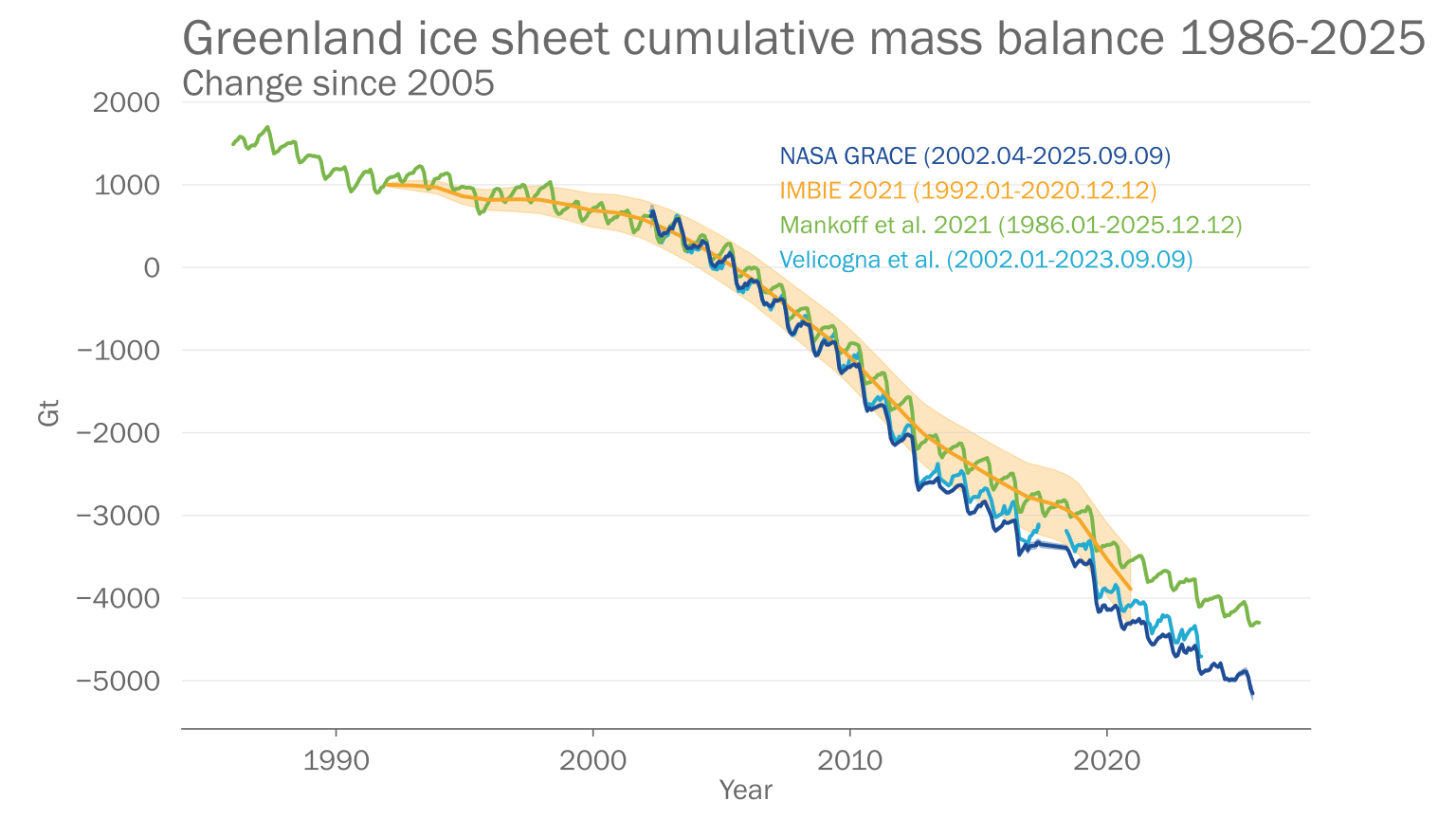
In the Mankoff et al. 2021 data set, the mass change between September 2024 and August 2025 was -107.39Gt, which is a smaller loss than the average for 2005-2024 of -217.00Gt.
Paragraph updated: 2026-03-17 14:19
Dataset and processing details
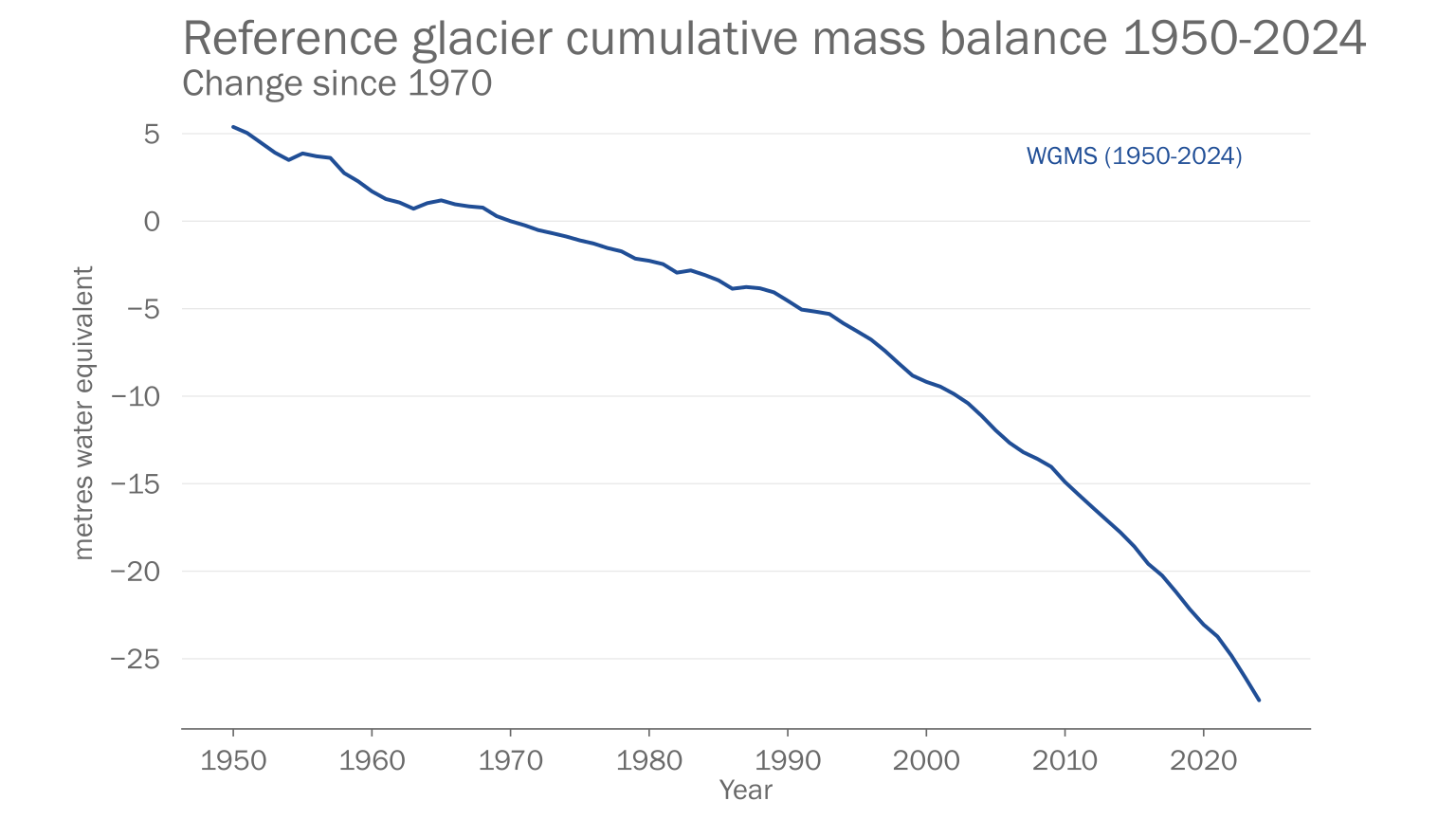
Reference glacier mass balance
Glaciers are measured using a variety of different techniques. Glacier mass balance data for the global network of reference glaciers are available from the World Glacier Monitoring Service (WGMS), https://www.wgms.ch.
The data in the above plot are available in a zip file containing a csv file for each data set.
Data file: Reference_glacier_mass_balance_data_files.zip
Checksum: b980ed5df5629b189960f9cd40800b81
Format: BADC CSV format
WGMS
Original data file (external link)
Citation:
Data citation: WGMS (2017, updated, and earlier reports): Global Glacier Change Bulletin No. 2 (2014-2015). Zemp, M., Nussbaumer, S. U., Gärtner-Roer, I., Huber, J., Machguth, H., Paul, F., and Hoelzle, M. (eds.), ICSU(WDS)/IUGG(IACS)/UNEP/UNESCO/WMO, World Glacier Monitoring Service, Zurich, Switzerland, 244 pp., based on database version: doi:10.5904/wgms-fog-2018-11.
To produce the plot, the following processing steps were performed:
- Data set created from file ['mb_ref.csv'] downloaded from ['http://wgms.ch/data/faq/mb_ref.csv'] at ['2026-02-25 10:15:25']
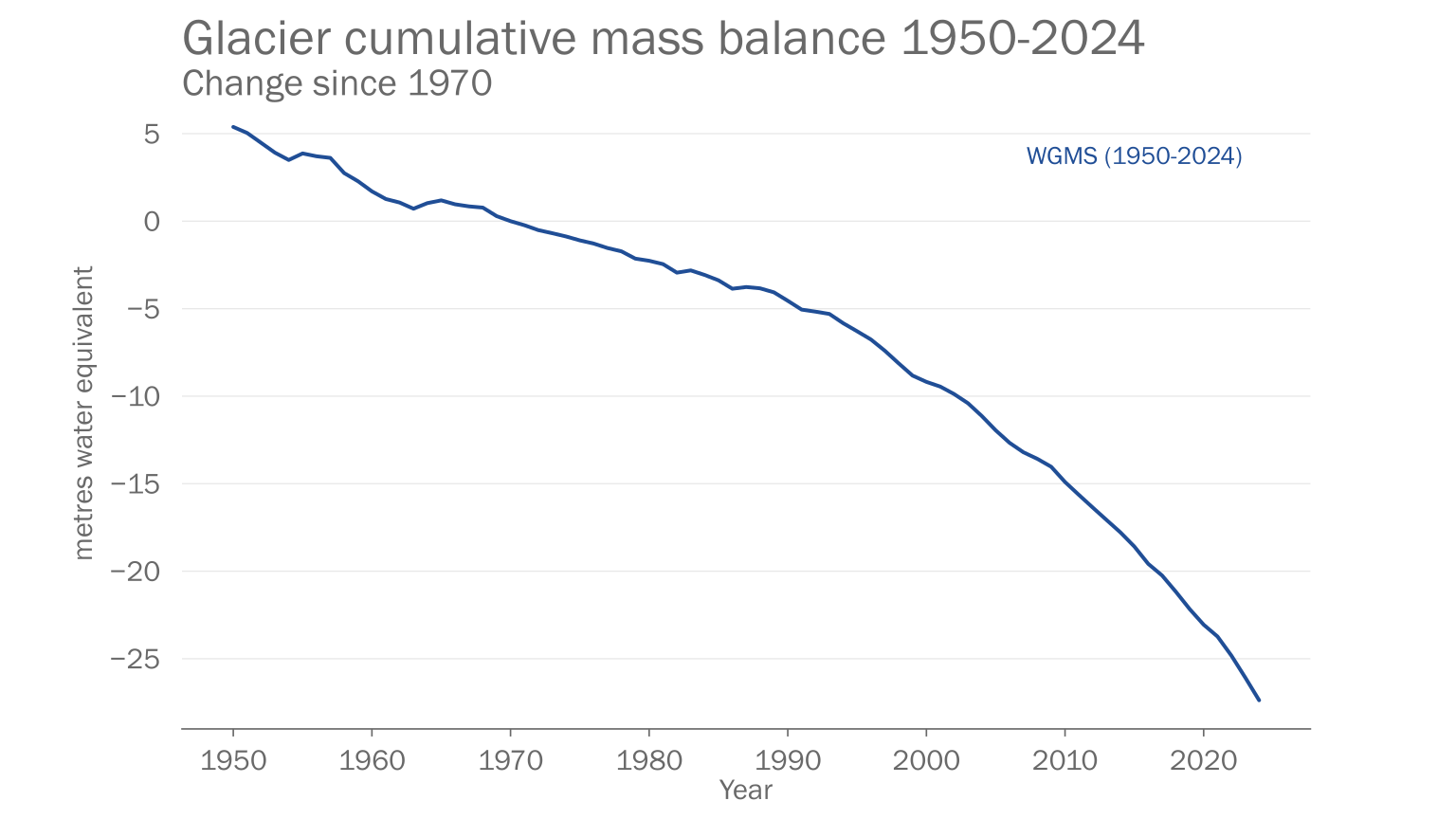
Glacier mass balance
Glaciers are measured using a variety of different techniques. Glacier mass balance data for the global network of reference glaciers are available from the World Glacier Monitoring Service (WGMS), https://www.wgms.ch.
The data in the above plot are available in a zip file containing a csv file for each data set.
Data file: Glacier_mass_balance_data_files.zip
Checksum: 2add57f79aa80dbb5d4dc1218c91d0f3
Format: BADC CSV format
GLAMBIE
Original data file (external link)
Citation:
Data citation: The GlaMBIE Team (2024): Glacier Mass Balance Intercomparison Exercise (GlaMBIE) Dataset 1.0.0. World Glacier Monitoring Service (WGMS), Zurich, Switzerland. https://doi.org/10.5904/wgms-glambie-2024-07
To produce the plot, the following processing steps were performed:
- Data set created from file ['0_global.csv'] downloaded from ['https://doi.org/10.5904/wgms-glambie-2024-07'] at ['2026-01-14 14:17:52']
Greenland ice sheet
The Greenland ice sheet mass balance measures the change in ice mass of the Greenland ice sheet. The change in mass is estimated in three principle ways: gravimetric measurements, altimetric measurements and the input-output method. Gravimetric measurements infer mass changes from variations in the Earth's gravitational field as measured by the GRACE and GRACE-FO (Gravity Recovery and Climate Experiment - Follow On) satellites. Altimetric measurements, measured the height of the ice sheet surface, using radar and laser altimeters. Input-output methods, use weather conditions from a numerical weather prediction model, to estimate changes in mass balance at the surface of the ice sheet. These are combined with estimates of mass loss from glaciers around the edge of Greenland and melting on the underside of the glaciers. The IMBIE data set combines over 25 different estimates of Greenland mass balance to get a comprehensive view of the long-term changes.
The data in the above plot are available in a zip file containing a csv file for each data set.
Data file: Greenland_ice_sheet_data_files.zip
Checksum: 26f7647194a301c2556bfb00263a6118
Format: BADC CSV format
NASA GRACE
Original data file (external link)
Citation:
Data citation: Wiese, D. N., D.-N. Yuan, C. Boening, F. W. Landerer, and M. M. Watkins (2019) JPL GRACE and GRACE-FO Mascon Ocean, Ice, and Hydrology Equivalent Water Height RL06M CRI Filtered Version 2.0, Ver. 2.0, PO.DAAC, CA, USA. Dataset accessed [2026-01-14 14:09:10] at http://dx.doi.org/10.5067/TEMSC-3MJ62.
Notes: Data from the GRACE and GRACE-FO JPL RL06Mv2 Mascon Solution
To produce the plot, the following processing steps were performed:
- Data set created from file ['greenland_mass_200204_2026MMMM.txt'] downloaded from ['https://archive.podaac.earthdata.nasa.gov/podaac-ops-cumulus-protected/GREENLAND_MASS_TELLUS_MASCON_CRI_TIME_SERIES_RL06.3_V4/greenland_mass_200204_2026MMMM.txt'] at ['2026-01-14 14:09:10']
- Zeroed series on July 2005 by subtracting the value for that month from all data values (see next entry)
- Added offset of 615.51 to all data values.
- Manually changed baseline to 2005-2005. Note that data values remain unchanged.
IMBIE 2021
Original data file (external link)
Citation:
Data citation: Shepherd, A., Ivins, E., Rignot, E., Smith, B., van den Broeke, M., Velicogna, I., Whitehouse, P., Briggs, K., Joughin, I., Krinner, G., Nowicki, S., Payne, A., Scambos, T., Schlegel, N., A, G., Agosta, C., Ahlstrøm, A., Babonis, G., Barletta, V., … Wuite, J. (2021). Antarctic and Greenland Ice Sheet mass balance 1992-2020 for IPCC AR6 (Version 1.0) [Data set]. UK Polar Data Centre, Natural Environment Research Council, UK Research & Innovation. https://doi.org/10.5285/77B64C55-7166-4A06-9DEF-2E400398E452
To produce the plot, the following processing steps were performed:
- Data set created from file ['imbie_greenland_2021_Gt.csv'] downloaded from ['https://ramadda.data.bas.ac.uk/repository/entry/get/imbie_greenland_2021_Gt.csv?entryid=synth%3A77b64c55-7166-4a06-9def-2e400398e452%3AL2ltYmllX2dyZWVubGFuZF8yMDIxX0d0LmNzdg%3D%3D'] at ['2023-08-07 14:40:20']
- Zeroed series on July 2005 by subtracting the value for that month from all data values (see next entry)
- Added offset of 1000.3866 to all data values.
- Manually changed baseline to 2005-2005. Note that data values remain unchanged.
Mankoff et al. 2021
Original data file (external link)
Citation:
Data citation: https://doi.org/10.22008/FK2/OHI23Z
Notes: Filename should be MB_SMB_D_BMB.csv
To produce the plot, the following processing steps were performed:
- Data set created from file ['MB_SMB_D_BMB.csv'] downloaded from ['https://thredds.geus.dk/thredds/fileServer/MassBalance/MB_SMB_D_BMB.csv'] at ['2026-01-22 15:42:39']
- Zeroed series on July 2005 by subtracting the value for that month from all data values (see next entry)
- Added offset of 1453.376009 to all data values.
- Manually changed baseline to 2005-2005. Note that data values remain unchanged.
Antarctic ice sheet
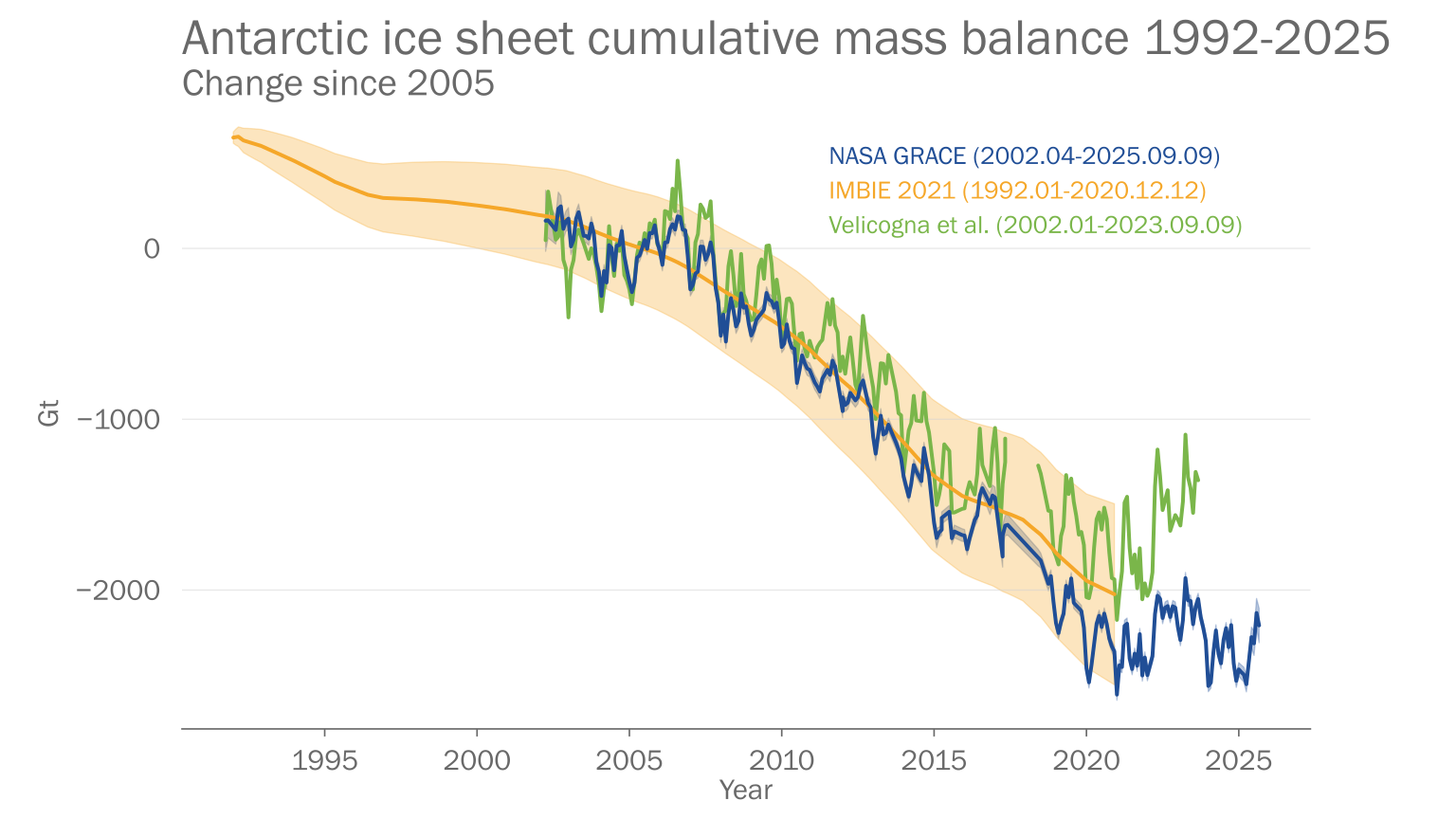
The Antarctic ice sheet mass balance measures the change in ice mass of the Antarctic ice sheet. The change in mass is estimated in three principle ways: gravimetric measurements, altimetric measurements and the input-output method. Gravimetric measurements infer mass changes from variations in the Earth's gravitational field as measured by the GRACE and GRACE-FO (Gravity Recovery and Climate Experiment - Follow On) satellites. Altimetric measurements, measured the height of the ice sheet surface, using radar and laser altimeters. Input-output methods, use weather conditions from a numerical weather prediction model, to estimate changes in mass balance at the surface of the ice sheet. These are combined with estimates of mass loss from glaciers around the edge of the continent and melting on the underside of the glaciers. The IMBIE data set combines many estimates of Antarctic mass balance to get a comprehensive view of the long-term changes.
The data in the above plot are available in a zip file containing a csv file for each data set.
Data file: Antarctic_ice_sheet_data_files.zip
Checksum: c2bebfc718c79e60d24c661b06eb47f8
Format: BADC CSV format
NASA GRACE
Original data file (external link)
Citation:
Data citation: Wiese, D. N., D.-N. Yuan, C. Boening, F. W. Landerer, and M. M. Watkins (2019) JPL GRACE and GRACE-FO Mascon Ocean, Ice, and Hydrology Equivalent Water Height RL06M CRI Filtered Version 2.0, Ver. 2.0, PO.DAAC, CA, USA. Dataset accessed [2026-01-14 14:09:32] at http://dx.doi.org/10.5067/TEMSC-3MJ62.
Notes: Data from the GRACE and GRACE-FO JPL RL06Mv2 Mascon Solution
To produce the plot, the following processing steps were performed:
- Data set created from file ['antarctica_mass_200204_2026MMMM.txt'] downloaded from ['https://archive.podaac.earthdata.nasa.gov/podaac-ops-cumulus-protected/ANTARCTICA_MASS_TELLUS_MASCON_CRI_TIME_SERIES_RL06.3_V4/antarctica_mass_200204_2026MMMM.txt'] at ['2026-01-14 14:09:32']
- Zeroed series on June 2005 by subtracting the value for that month from all data values (see next entry)
- Added offset of 162.11 to all data values.
- Manually changed baseline to 2005-2005. Note that data values remain unchanged.
IMBIE 2021
Original data file (external link)
Citation:
Data citation: Shepherd, A., Ivins, E., Rignot, E., Smith, B., van den Broeke, M., Velicogna, I., Whitehouse, P., Briggs, K., Joughin, I., Krinner, G., Nowicki, S., Payne, A., Scambos, T., Schlegel, N., A, G., Agosta, C., Ahlstrøm, A., Babonis, G., Barletta, V., … Wuite, J. (2021). Antarctic and Greenland Ice Sheet mass balance 1992-2020 for IPCC AR6 (Version 1.0) [Data set]. UK Polar Data Centre, Natural Environment Research Council, UK Research & Innovation. https://doi.org/10.5285/77B64C55-7166-4A06-9DEF-2E400398E452
To produce the plot, the following processing steps were performed:
- Data set created from file ['imbie_antarctica_2021_Gt.csv'] downloaded from ['https://ramadda.data.bas.ac.uk/repository/entry/get/imbie_antarctica_2021_Gt.csv?entryid=synth%3A77b64c55-7166-4a06-9def-2e400398e452%3AL2ltYmllX2FudGFyY3RpY2FfMjAyMV9HdC5jc3Y%3D'] at ['2023-08-07 14:40:19']
- Zeroed series on June 2005 by subtracting the value for that month from all data values (see next entry)
- Added offset of 646.1411 to all data values.
- Manually changed baseline to 2005-2005. Note that data values remain unchanged.
Page created on 2026-03-17 using climind v1.3.0